



Julian Lovato — Kewa (Santo Domingo) Silversmith & His Mark
Julian Lovato, 1925–2018. Kewa Pueblo. The man they trusted to keep the Thunderbird.
When the Thunderbird Shop in Santa Fe closed its doors in 1964, someone had to be trusted with its hallmark — the mark that stood for Frank Patania Sr., the Italian-born master who had brought a modernist eye to Southwestern silver. That trust went to Julian Lovato. Patania's widow, Aurora, gave him the thunderbird stamp (Hougart 2020, p. 54), and Lovato became known in the trade as the "Keeper of the Thunderbird." It's a fitting title for a man whose whole body of work was about carrying a tradition forward while making it new.
The Smith
He was born in 1925 at Kewa (Santo Domingo) Pueblo — the New Mexico pueblo famous above all others for heishi, the fine hand-rolled shell and stone beadwork. His parents were expert heishi makers and jewelers, and they were his first teachers. As a young man he worked at Maisel's trading post in Albuquerque, served in the military, and then found his way to the Thunderbird Shop, where he worked under Frank Patania Sr. and absorbed the modernist design sense that would reshape his own. Later he moved on to Packards, and by the 1970s had set up his own studio back home at Kewa, working closely with his wife, Marie O. Lovato, of Ohkay Owingeh. He died in 2018, and in 2026 the Wheelwright Museum mounted the first solo exhibition ever dedicated to him — Silver Honors Stone — eighty works drawn from museum and private collections. It runs in Santa Fe through October 2026; visit the exhibition.
The Work
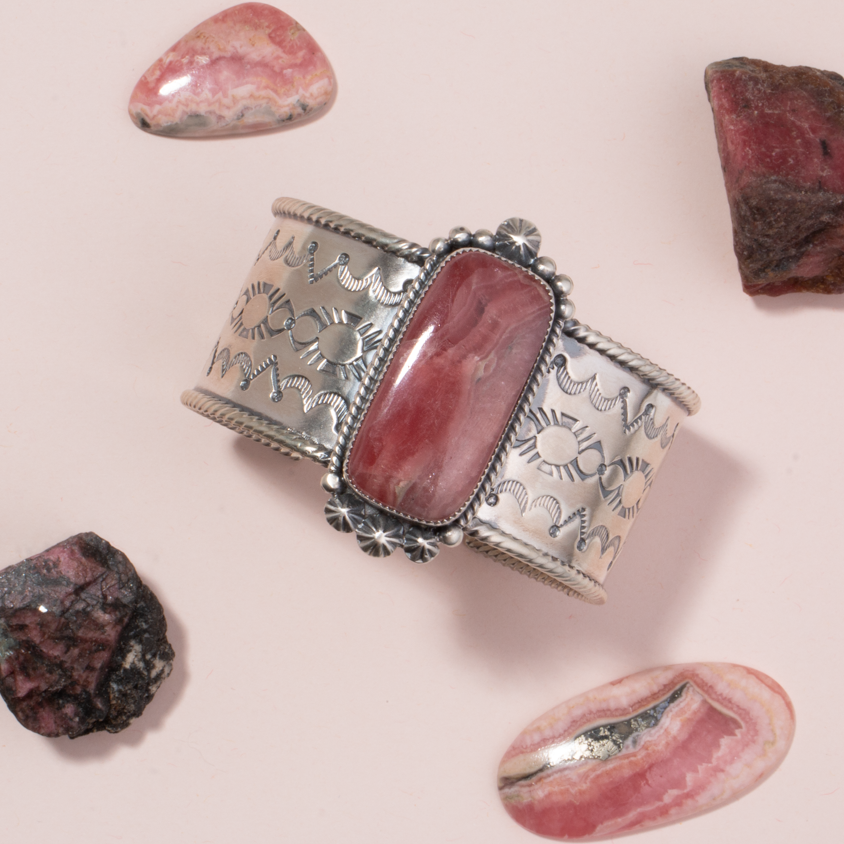
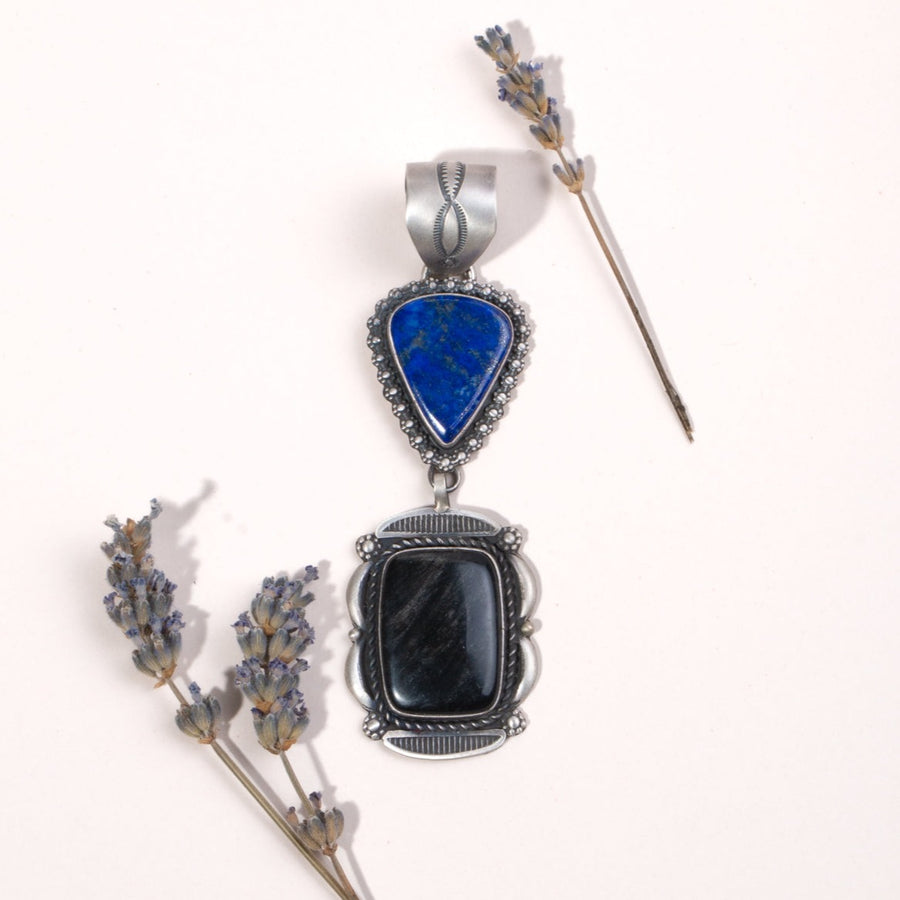
Lovato called his signature approach "raised, dimensional jewelry design" — a sculptural, high-relief way of building silver that lifts the metal off the flat and gives it depth. Into it he folded two things that don't obviously belong together: the traditional Kewa design language he grew up with, simplified and modernized, and the clean modernist aesthetic he learned at Patania's bench. He worked heavy, high-grade silver and was exacting about stone, choosing top-quality turquoise and coral for each piece so the setting had something worth showcasing — which is exactly what his museum retrospective's title says: silver honors stone. On pieces made after 1964 you'll find the Thunderbird Shop mark alongside his own, the visible sign of the lineage he was handed.
The Standing
Dealers and curators alike place Lovato in the top rank of twentieth-century Native silversmiths, in the company of Charles Loloma, Kenneth Begay, and Joe H. Quintana — the generation of Pueblo and Diné makers who stepped out as named, independent designers rather than anonymous production hands. The Wheelwright's 2026 exhibition frames his career precisely there, running alongside contemporaries like the Hopi silversmith Lewis Lomay and Cochiti's Joe Quintana — father of Cippy Crazyhorse, whose own page carries the same Patania Thunderbird thread forward in this directory. For a jeweler who spent his life quietly synthesizing the old and the new, it's a late and fitting recognition.
Know more about Julian? Contact T.Skies.
- Pardue, Diana F. Contemporary Southwestern Jewelry + Bahti, Mark. Silver + Stone.
- Silver Honors Stone: The Work of Julian Lovato — Wheelwright Museum of the American Indian (2026)
- Julian Lovato biography — Medicine Man Gallery
- Julian Lovato: Kewa Silversmith — Arthur W. Erickson
From the Library: Baxter, Encyclopedia of Native American Jewelry (2000)
2000 primary source. Anything described as current here describes 2000, not today.
Baxter (2000) dated his Thunderbird Shop years:
“Lovato then worked in Frank Patania’s Thunderbird Shop in Santa Fe, New Mexico, from 1946 to 1968.”
— Baxter (2000), p. 103 [1]
According to Baxter (2000, p. 103), as a tribute to their relationship of mutual respect and learning, Lovato inherited Patania's hallmark stamp, the thunderbird, upon Patania's death in 1968. [1]
Baxter (2000) described one of his forms:
“He makes raised or dimensional pieces, including shaped corn necklaces with stonework resembling corn kernels.”
— Baxter (2000), p. 103 [1]
Baxter (2000) dated the start of his awards:
“Lovato has won many awards at all the major Indian art venues, starting with his first entry at the 1977 Gallup Inter-tribal Indian Ceremonial and continuing into the 1980s and 1990s.”
— Baxter (2000), p. 103 [1]
From the Library: Tryk, Santa Fe Indian Market (1993)
1993 primary source. Anything described as current here describes 1993, not today.
Tryk (1993, p. 81) recorded that Julian Lovato, Santo Domingo, had been making jewelry since he was 14 years old, and pictured silver and coral pieces she called typical of his work. [3]
From the Library: Schaaf, American Indian Jewelry I (2003)
2003 primary source. Anything described as current here describes 2003, not today.
Schaaf (2003) recorded a mark of his:
“stylized eagle with a four-pointed star on each wing used in 1972”
— Schaaf (2003), p. 226 [4]
Schaaf (2003, p. 226) recorded Julian Lovato as Santo Domingo, born about 1925 and active from about 1938 in traditional silver jewelry, the husband of Marie Lovato, who entered his first Gallup Inter-tribal Ceremonial in 1977, showed at Indian Market from 1979 to 2002, and worked as a stone cutter for Maisels in Albuquerque. [4]
Schaaf (2003) noted:
“(Patania passed his thunderbird hallmark to Julian.)”
— Schaaf (2003), p. 227 [4]
Field Notes by Mateo James
Our page has the Thunderbird Shop closing in 1964 and the stamp passing to Julian after that. Baxter's 2000 encyclopedia has him working at the shop from 1946 to 1968 and inheriting the stamp on Patania's death in 1968. I show both dates as printed.
Sources
- Baxter, Paula A., with Allison Bird-Romero. Encyclopedia of Native American Jewelry: A Guide to History, People, and Terms. Phoenix: Oryx Press, 2000. Cited by printed page. Statements describe conditions as of 2000.
- Hougart, Bille. 100 Collectible Native American Silversmiths and Their Hallmarks. TBR International, Inc., 2020.
- Tryk, Sheila. Santa Fe Indian Market: Showcase of Native American Art. Photography by Mark Nohl; introduction by Allan Houser. Santa Fe, NM: Tierra Publications, in cooperation with SWAIA (Southwestern Association on Indian Affairs), 1993. Cited by printed page. Statements describe conditions as of 1993.
- Schaaf, Gregory, with Angie Yan Schaaf. American Indian Jewelry I: 1,200 Artist Biographies, ca. 1800-present. American Indian Art Series, Vol. 5. Santa Fe: CIAC Press, 2003. Cited by printed page. Statements describe conditions as of 2003.
This profile is maintained in support of Native American silversmiths and compiled from published references. See something inaccurate, or want to add to it? Contact us.