



Cippy Crazyhorse — Cochiti Pueblo Silversmith & His Marks
Cipriano Quintana, b. 1946, Cochiti Pueblo. The middle of a three-generation line.
Cippy Crazyhorse makes silver that looks a hundred years old the day it leaves his bench — heavy, hand-stamped, clean of any decoration it doesn't need. That's not an accident of style; it's a lineage. He works the classic Pueblo tradition his parents worked before him, and his son works after him.
The Marks
Crazyhorse signs his work "CZH," and also with two back-to-back C's, alongside a STERLING stamp. (Adobe Gallery has captured his hallmark on documented pieces — a good reference for identifying his hand.)
The Smith
He was born Cipriano Quintana in 1946 at Cochiti Pueblo, into a silversmithing family that mattered. His father, Joe H. Quintana, was called by one gallery "one of the finest silversmiths of his generation." His mother, Teresita, was a renowned jeweler in her own right.
Cippy came to the bench late, and by hard luck. He studied at Eastern New Mexico University, served in the Navy until 1972, and was working as an electrician's assistant on the construction of the Cochiti Dam when a workplace injury in 1974 ended that work. In his own telling, the injury "forced his hand at silversmithing." He started small — making silver chain — and taught himself the old Pueblo way, with steady encouragement from his father and his wife, Susan. He has made jewelry every year since.
His son, Waddie Crazyhorse, is a respected working jeweler today — making the Quintanas a three-generation Cochiti line: Joe to Cippy to Waddie.
The Work
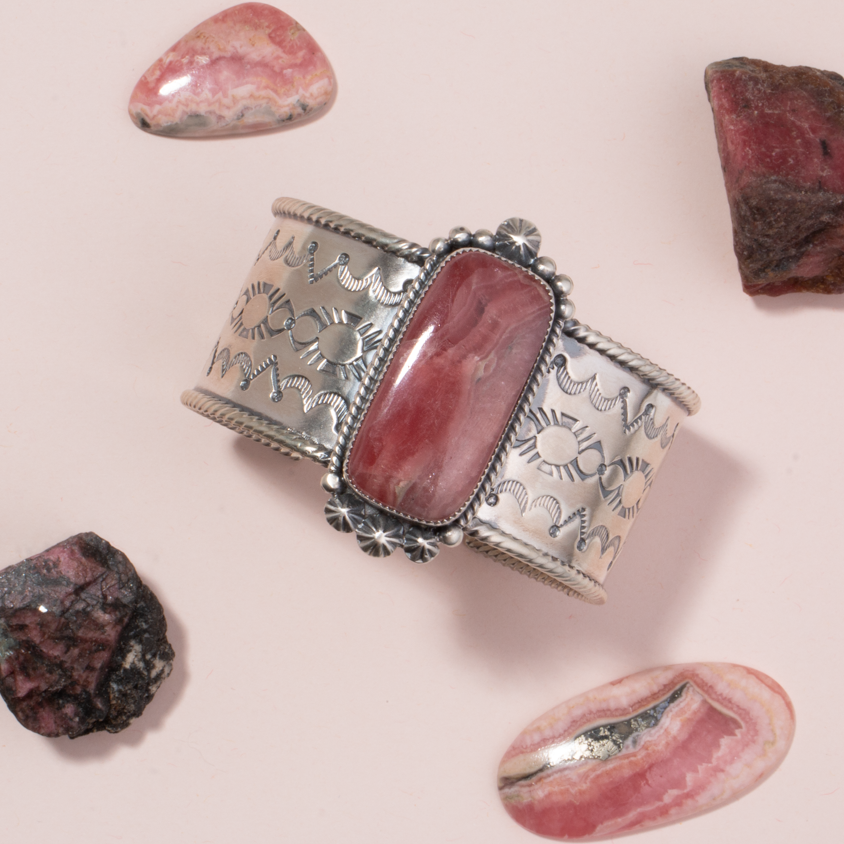
Crazyhorse's trademark is weight — thick-gauge silver worked with deep stamp-and-chisel. Much of that silver he pours himself, melting scrap into ingots the way, he says, "the old timers" did. His forms are the traditional Pueblo vocabulary — cuff bracelets, concha belts, ranger-set buckles, bead necklaces — built with antique stamps and early techniques so that the finished piece reads, as Adobe Gallery puts it, "clean and uncluttered" with "a look of being incredibly old." It's a deliberate effect: contemporary work made to hold the weight of the classic era.
He is precise about where he stands in the craft. "There are traditional classic styles in silver jewelry, the Navajo and the Pueblo," he has said, "and I do the latter." His work carries no pictorial or narrative iconography — it is the pure Pueblo silver form.
The Standing
Over more than thirty-five years at Santa Fe Indian Market, Crazyhorse has taken numerous ribbons, and has served as a jewelry judge there himself. In 1990 he co-curated the exhibition "Steady Hands, White Metal" at the Museum of Indian Arts and Culture in Santa Fe with fellow jeweler Yazzie Johnson. The Santa Fean named him one of Indian Market's "Seven Standouts" in 2008, and his classic Cochiti work has a devoted following in Japan.
Know more about Cippy? Contact T.Skies.
- Pardue, Diana. Contemporary Southwestern Jewelry + The Cutting Edge (quoted via Bischoff's Gallery).
- Bahti, Mark. Silver + Stone: Profiles of American Indian Jewelers. Rio Nuevo Publishers.
- Cippy Crazyhorse (Cipriano Quintana, b. 1946) — Adobe Gallery
- Cippy Crazyhorse — official site
- Cippy Crazy Horse — Bischoff's Gallery
From the Library: Ryan & Chambless, Turquoise in America Part Two: 1910–1990 (2020)
2020 primary source. Anything described as current here describes 2020, not today.
Cippy Crazyhorse recalled, in an interview published by Ryan & Chambless (2020, p. 159), that years after John Adair wrote about his father, Adair knocked on the window while Cippy was working in his father's old place, by then his own workshop, and the two talked over old times. [1]
Cippy Crazyhorse recalled, in an interview published by Ryan & Chambless (2020, p. 226), that he started out making silver chains in a rebuilt adobe next to his mobile home, and that his first buyer was Rex Arrowsmith at his shop on Old Santa Fe Trail, with Al Packard and Bob Ward among his other early connections. [1]
In his own words, from an interview published by Ryan & Chambless (2020):
“The ones that really gave me the big break were Ray and Judy Dewey at the Treasure Chest, then on San Francisco Street in Santa Fe.”
— Ryan & Chambless (2020), p. 226 [1]
From the Library: Tryk, Santa Fe Indian Market (1993)
1993 primary source. Anything described as current here describes 1993, not today.
Tryk (1993, p. 63) pictured a necklace by Cippy Crazyhorse with Isleta crosses and a naja. [2]
Tryk (1993, p. 61) showed him at work, from careful measuring to strenuous hammering and precise punching, and pictured his concha pin, belt buckle, concha belt and belt set, and a serpent bolo tie she said recalled ancient wall paintings. [2]
From the Library: Schaaf, American Indian Jewelry I (2003)
2003 primary source. Anything described as current here describes 2003, not today.
Schaaf (2003) dated his change of name:
“With his father’s blessings, he changed his name in 1975 to Cippy Crazy Horse”
— Schaaf (2003), p. 125 [3]
Schaaf (2003, p. 125) listed his work in the British Museum and recorded the George West Memorial Award for Jewelry in 1981 and the Squash Blossom of Colorado Award in 1986 at Indian Market, among many prizes there from 1978 to 1991. [3]
Schaaf's 2003 hallmark index gives CZH under both of his names:
“CZH (Cipriano Quintana, Cippy Crazy Horse)”
— Schaaf (2003), p. 168 [3]
Sources
- Ryan, Mike, II, and Philip Chambless. Turquoise in America, Part Two: 1910–1990. Callais Press, 2020. Cited by printed page. Statements describe conditions as of 2020.
- Tryk, Sheila. Santa Fe Indian Market: Showcase of Native American Art. Photography by Mark Nohl; introduction by Allan Houser. Santa Fe, NM: Tierra Publications, in cooperation with SWAIA (Southwestern Association on Indian Affairs), 1993. Cited by printed page. Statements describe conditions as of 1993.
- Schaaf, Gregory, with Angie Yan Schaaf. American Indian Jewelry I: 1,200 Artist Biographies, ca. 1800-present. American Indian Art Series, Vol. 5. Santa Fe: CIAC Press, 2003. Cited by printed page. Statements describe conditions as of 2003.
This profile is maintained in support of Native American silversmiths and compiled from published references. See something inaccurate, or want to add to it? Contact us.