



Howard Sice — Hopi/Laguna Silversmith & His Mark
b. 1948, Winslow, Arizona. Two pueblos in one hand.
Howard Sice was born to a Hopi mother and a Laguna father, and raised across both worlds — home base on the Laguna Pueblo, in the village of Paraje, but season after season spent with aunts in the Hopi villages of Walpi, Kykotsmovi, and Polacca. Dealers who've handled his work for decades all say the same thing: you can see both cultures in the jewelry. His whole career is the art of a man who belongs to two pueblos and lets each one into the silver.
The Smith
He came to jewelry the long way around. Sice served twenty years in the United States Air Force, including Vietnam, and earned a Bachelor of Science in Human Resources Management along the way. He began making jewelry in 1972, while still in uniform — and taught himself, with no named master, in traditional silver and goldsmithing. The turn that made his name came in 1985, when he added engraving to his repertoire. That's the year, as one longtime dealer puts it, the work became unmistakably "a Sice Design."
The Work
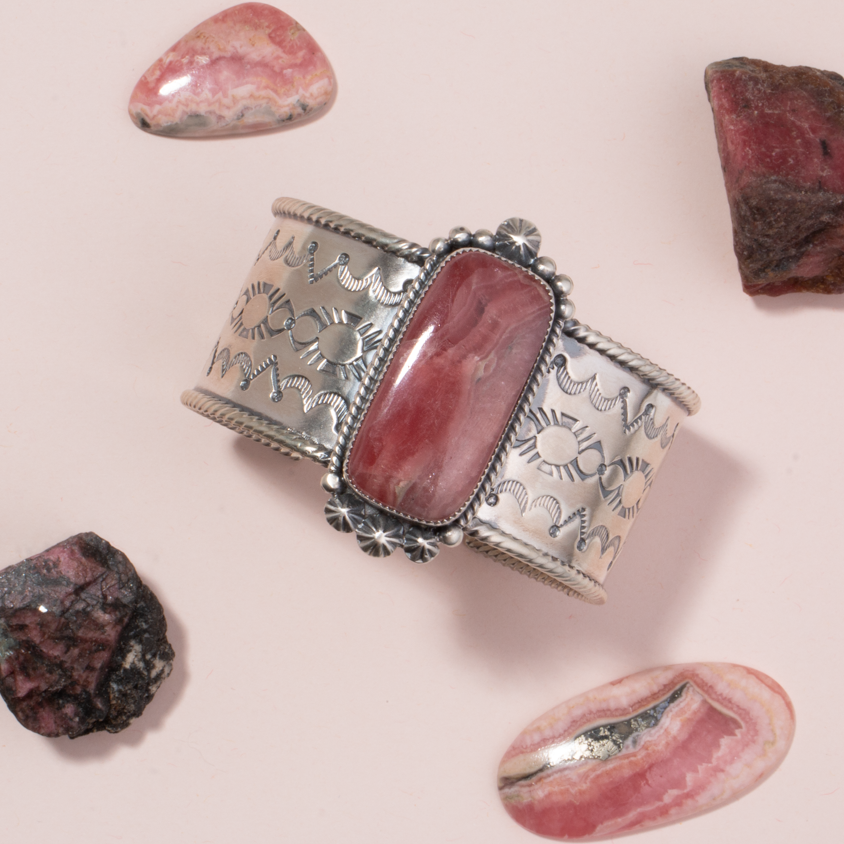
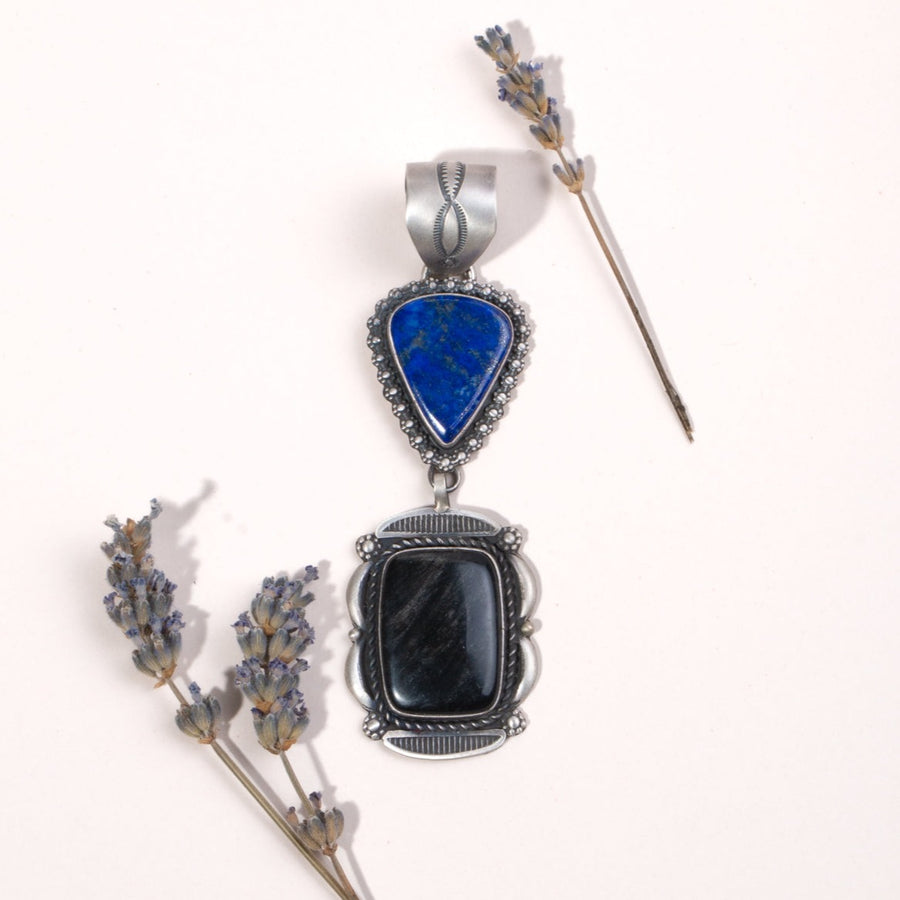
Sice is an engraver first — his signature is hand stamping, scoring, and fine engraving, not casting or channel inlay. Adobe Gallery describes one of his bracelets, a sun framed by feathers, as "meticulously stamped and scored," and calls that control "a hallmark of Sice's ability to transform silver into detailed works of art." He also works as a kind of translator of the deep past: he'll take a design off an ancient pottery shard or a petroglyph and engrave it, at its exact size and shape, onto a silver pin or pendant. His stone-set pieces pair that engraved silver with cabochon turquoise, azurite, and Montana banded agate.
He's also a restless technician. In recent years he moved much of his work to Argentium sterling — a silver-germanium alloy that stays bright and resists tarnish — and has experimented with niobium and precious-metal clay, carved and then fired onto metal. His range runs past jewelry entirely: he designed four water-acoustic vessels for Phoenix's Squaw Peak Parkway (1992) and a hundred street medallions for the city's Central Avenue beautification project (1990).
The Mark
This is one of the better-documented hallmarks in the directory. Sice stamps "Sice Sterling" on the back of his work — a mark that two independent galleries, Adobe and Medicine Man, have both photographed and published in their hallmark references. On pieces made in registered Argentium silver, you'll also find the trademarked "flying unicorn" Argentium stamp — that one marks the alloy, not the maker, so don't mistake it for a second signature.
The Standing
Sice took Best of Show at the Museum of Northern Arizona's Hopi Show in both 1990 and 1999, Best of Show at the Sharlot Hall Museum (1999), and a First Place at the Heard Museum. Arizona named him to a Governor's Arts Award in 1993, and the Southwestern Association for Indian Arts (SWAIA) recognized him as a Master Artist and Fellowship recipient. He shows regularly at Santa Fe Indian Market, and his work has been exhibited at the Museum of Indian Arts and Culture and the Arizona State Museum.
Know more about Howard? Contact T.Skies.
- Bahti, Mark. Silver + Stone: Profiles of American Indian Jewelers.
- Howard Sice, Hopi Pueblo Jeweler — Adobe Gallery
- Howard Sice — Tanner Chaney
- Howard Sice — Garland's
- Sice, Howard (Hopi/Laguna) hallmark index — Medicine Man Gallery
From the Library: Bahti, Silver + Stone: Profiles of American Indian Jewelers (2007)
2007 primary source. Anything described as current here describes 2007, not today.
As Howard Sice told Bahti (2007):
“I chose engraving for my work because there was no one doing it”
— Bahti (2007), p. 164 [1]
Speaking to Bahti (2007), Howard described his wife Patricia's part in the work:
“Patricia started helping right at the beginning and is instrumental in quality control and some in design.”
— Bahti (2007), p. 164 [1]
According to Bahti (2007, p. 164), Patricia's father showed Howard how to solder and set stones, and Howard learned much of the rest by repairing jewelry while stationed in Ohio, including pieces by Gibson Nez, Quandelacy and Charles Loloma, which gave him the chance to study their work. [1]
According to Bahti (2007, p. 164), Sice was reassigned to Davis-Monthan Air Force Base in Tucson in 1981, and by 1982 he had started engraving, following up an interest first sparked by the engraving of a Vandalia, Ohio, gunsmith. [1]
According to Bahti (2007, p. 164), the Sices began using titanium and niobium around 1985, which cannot be soldered and must be riveted; Howard learned the technique from Bill Seely in Jerome, Arizona, and also worked with Japanese alloys such as shakudo, mokume gane and shibuichi. [1]
According to Bahti (2007, p. 164), Howard's silver bowls began when Patricia saw a small silver bowl set with a single turquoise at the San Xavier festival and suggested he try one; as of 2007 he still had that first bowl, dwarfed by later bowls up to a foot across. [1]
Bahti (2007) recorded the motto Howard and Patricia gave Sice Design:
“Surprise the senses, challenge the normal, and change the future.”
— Bahti (2007), p. 165 [1]
From the Library: Wright, Hopi Silver (2003)
2003 primary source. Anything described as current here describes 2003, not today.
According to Wright (2003, p. 86), Howard Sice, of the Corn clan at Kykotsmovi, began silverwork in 1972, self-taught, and was still working when the listing was last revised; Wright records his Hopi mother and Laguna father and shows his marks SICE and Sice in script. [2]
From the Library: Schaaf, American Indian Jewelry I (2003)
2003 primary source. Anything described as current here describes 2003, not today.
Schaaf (2003) entered him as
“Howard Sice (signs SICE)”
— Schaaf (2003), p. 288 [3]
Schaaf (2003, p. 288) recorded Howard Sice as Hopi/Laguna, of a Hopi mother and Laguna father, born about 1948 and active from about 1972 in overlay and engraved jewelry, silver jars, boxes and sculptures, the husband of Patricia Smith (Navajo), a twenty-year Air Force veteran of Vietnam, with the 1993 Governor's Arts Award in Phoenix. [3]
From the Library: Tryk, Santa Fe Indian Market (1993)
1993 primary source. Anything described as current here describes 1993, not today.
Tryk (1993, p. 210) identified H. J. Sice, Hopi-Laguna, as a SWAIA fellowship winner and a jeweler who had become known for his new and unusual silver pots. [4]
Field Notes by Mateo James
Our biography dates Howard's move into engraving to 1985, while Bahti's 2007 profile, built from an interview Howard reviewed, says he had started engraving by 1982 after moving to Tucson. The two may describe a first start and a later turning point, so I have shown both. Where they differ, Howard's own reviewed account in Bahti is the stronger source.
Sources
- Bahti, Mark. Silver + Stone: Profiles of American Indian Jewelers. Tucson: Rio Nuevo Publishers, 2007. Cited by printed page. Statements describe conditions as of 2007.
- Wright, Margaret Nickelson. Hopi Silver: The History and Hallmarks of Hopi Silversmithing. Revised edition. Albuquerque: University of New Mexico Press, 2003. Originally published by Northland Publishing. Cited by printed page. Statements describe conditions as of 2003.
- Schaaf, Gregory, with Angie Yan Schaaf. American Indian Jewelry I: 1,200 Artist Biographies, ca. 1800-present. American Indian Art Series, Vol. 5. Santa Fe: CIAC Press, 2003. Cited by printed page. Statements describe conditions as of 2003.
- Tryk, Sheila. Santa Fe Indian Market: Showcase of Native American Art. Photography by Mark Nohl; introduction by Allan Houser. Santa Fe, NM: Tierra Publications, in cooperation with SWAIA (Southwestern Association on Indian Affairs), 1993. Cited by printed page. Statements describe conditions as of 1993.
This profile is maintained in support of Native American silversmiths and compiled from published references. See something inaccurate, or want to add to it? Contact us.