



Charles Supplee — Hopi/French Goldsmith & His Mark
b. 1959. The Southwestern jeweler who works like a Paris goldsmith.
Most Southwestern silver is built flat — overlay on a sheet, stone set into a bezel, read from the front. Charles Supplee builds his the other way: in three dimensions, with movement, gold and stone assembled the way a European fine-jeweler assembles a ring. That difference has a direct source, and it isn't Hopi tradition alone. It's a two-year apprenticeship under a French master goldsmith — Old World technique, transplanted to Arizona.
The Smith
He was born in 1959 to a Hopi mother and a French father, a schoolteacher, and grew up on the Navajo Reservation. His father, a hobbyist jeweler, taught him silverwork basics at home — that's the real start, not a trip abroad. After high school he moved to Scottsdale to work as a bench silversmith at the Arizona Turquoise and Silver Company.
The turn came in the 1980s, when Supplee apprenticed for two years under Pierre Touraine. Touraine was a French-born goldsmith who had made jewelry for European celebrities in 1930s Paris, emigrated to the United States in 1938, worked for Harry Winston in New York, then settled in the Southwest — where, in the GIA's own words, "he taught European jewelry manufacturing techniques to Native American craftsmen." Supplee wasn't the only one in that circle (Charles Loloma, Harvey Begay, and Larry Golsh are named alongside him), but he became one of the clearest carriers of what Touraine taught: three-dimensional design and fine diamond setting. So the "French" in Charles Supplee isn't a passport stamp — it's a direct line to 1930s Paris goldsmithing, handed to him at a bench in Arizona.
He also works in bronze sculpture, photography, and painting.
The Work
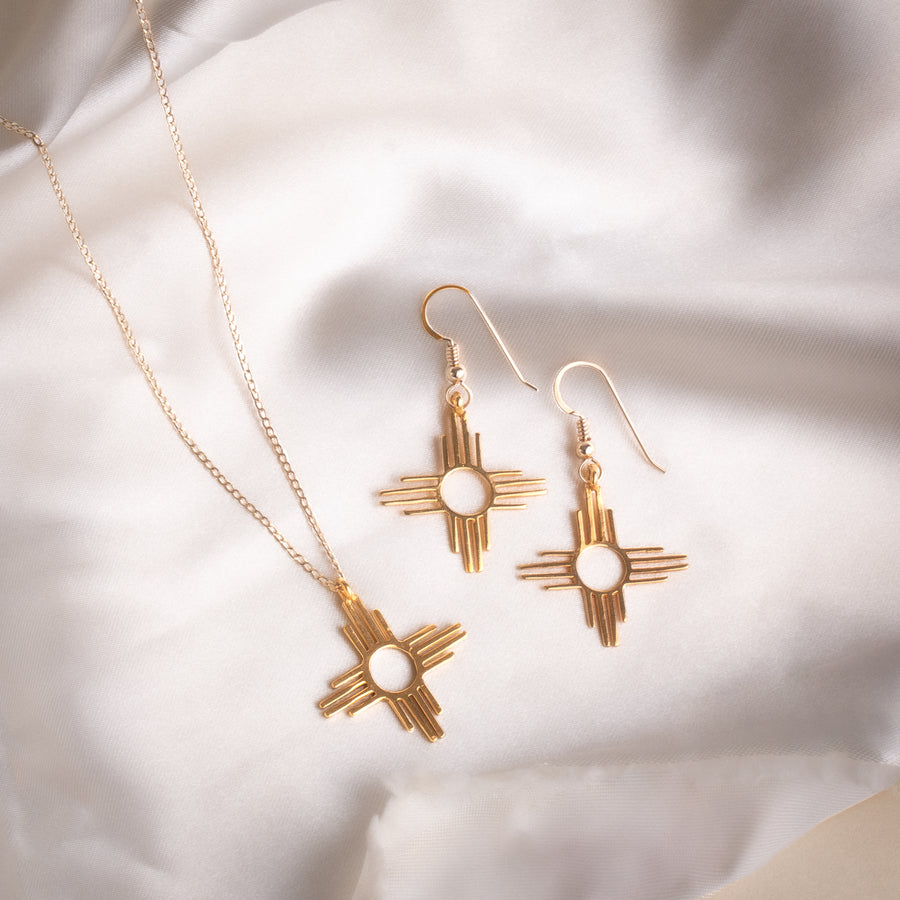
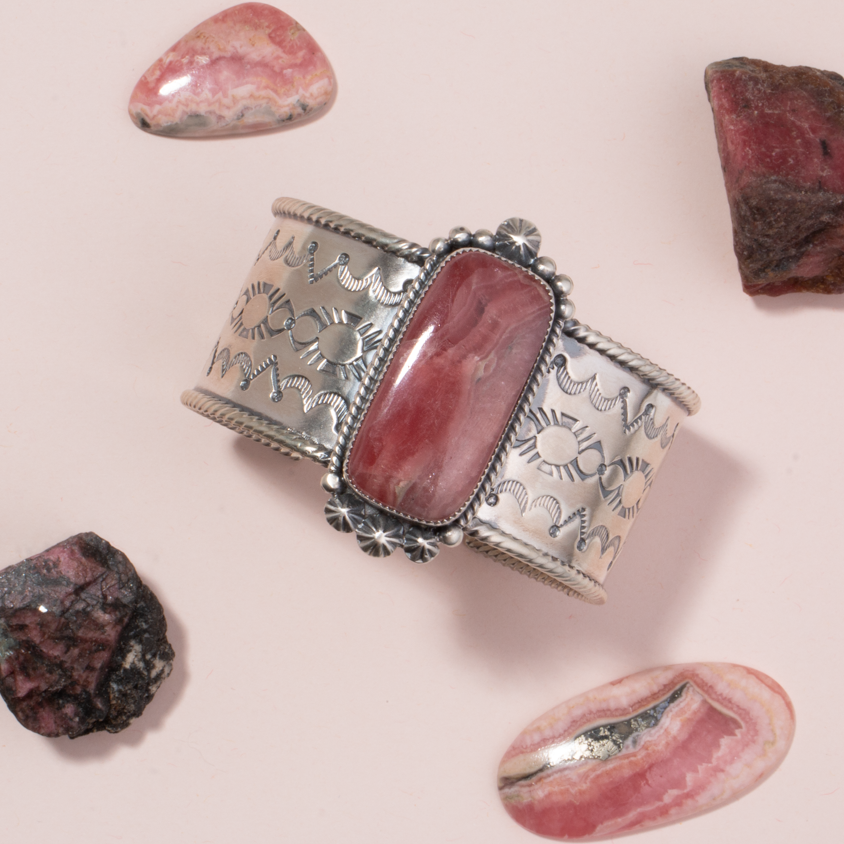
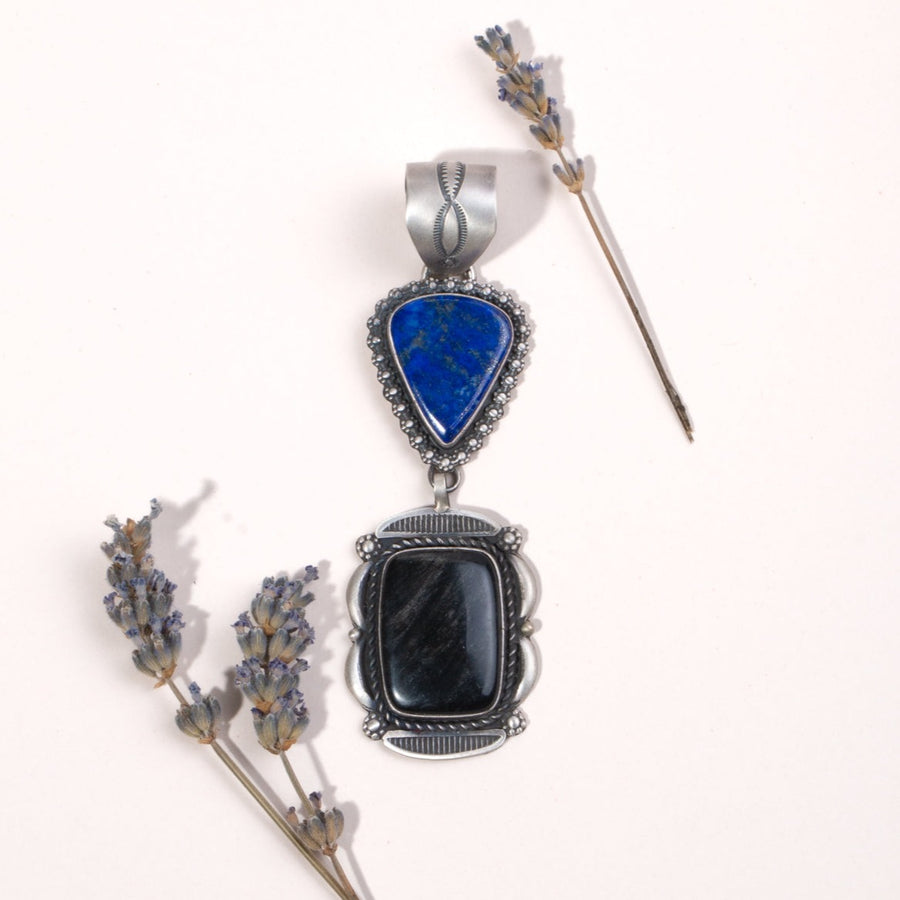
Supplee's jewelry combines forging, engraving, etching, casting, fabrication, and diamond-setting — a fuller construction kit than traditional silver-and-turquoise work uses — aimed at pieces that stand up off the hand and move. He favors 14k and 18k gold set with turquoise (including Morenci), coral, sugilite, and lapis, and he doesn't sketch first. "The more techniques you learn," he has said, "the less inhibited you are and the more freedom you have with what you want to make." Some pieces carry recurring Hopi-inspired decorative motifs — a corn design, a four-directions pattern — worked as ornament, in his own vocabulary.
The Standing
Supplee's work was shown in "Changing Hands: Art Without Reservation" (2002) at New York's American Craft Museum and "Jewels of the Southwest" (2002) in New Mexico, and appears in the standard reference shelf of the field — the Jackas' Beyond Tradition and Art of the Hopi, Dexter Cirillo's Southwestern Indian Jewelry, and Lois Dubin's North American Indian Jewelry and Adornment. He passed the craft to his younger brother Don Supplee, who apprenticed under him for three years before building his own career.
Know more about Charles? Contact T.Skies.
- Pardue, Diana F. Contemporary Southwestern Jewelry + Bahti, Mark. Silver + Stone: Profiles of American Indian Jewelers.
- Charles Supplee & Pierre Touraine — Faust Gallery
- Pierre Touraine Jewelry exhibit — GIA
- Charles Supplee biography — Medicine Man Gallery
- Charles Supplee — Waddell Gallery
- Native American Innovators — Southwest Art Magazine
From the Library: Wright, Hopi Silver (2003)
2003 primary source. Anything described as current here describes 2003, not today.
According to Wright (2003, p. 65), Charles Supplee and his brother Don, Hopi brothers who had never lived on the mesas, were raised in Flagstaff, and their mother was from Kykotsmovi. [1]
According to Wright (2003, p. 65), after school Charles moved to Phoenix and studied under the French jeweler Pierre Touraine, who taught his students gold work and the setting of precious stones, and Charles later tutored his brother Don. [1]
According to Wright (2003, p. 91), Charles Supplee, of the Sun clan at Kykotsmovi, began silverwork in 1975 and was still working when the listing was last revised; Wright shows marks dated 1984, including a sun face, and a second sun face dated 1995. [1]
Wright (2003) summarised his training in one line:
“Studied with Pierre Touraine after he had learned the rudiments himself.”
— Wright (2003), p. 91 [1]
From the Library: Baxter, Encyclopedia of Native American Jewelry (2000)
2000 primary source. Anything described as current here describes 2000, not today.
Baxter (2000) traced his start:
“After graduation from high school in Flagstaff, Arizona, Supplee went to work in an Indian arts shop in Scottsdale. There, he met, and (in the 1970s) apprenticed with, master jeweler Pierre Touraine, who was impressed by Supplee’s fabrication abilities.”
— Baxter (2000), p. 169 [2]
Baxter (2000) singled out one body of his work:
“Among Supplee’s most notable artistic achievements are his twig ornament horse designs, based on an ancient artifact found in the Grand Canyon area.”
— Baxter (2000), p. 169 [2]
As of 2000, Baxter (2000, p. 169) described him fashioning these small horses from a base of willow branches and then casting them in silver and gold. [2]
From the Library: Schaaf, American Indian Jewelry I (2003)
2003 primary source. Anything described as current here describes 2003, not today.
Schaaf (2003, p. 111) wrote that Charles Supplee and Harvey Begay were among the Indian jewelers who joined the Isleta jeweler Ted Charveze in studying with the French designer Pierre Tourraine, as Schaaf spells the name, in Phoenix, where they learned European techniques in gold, diamonds and gemstones. [3]
Schaaf (2003, p. 106) recorded that the Hopi/Navajo overlay smith Iva Lee Casuse of Second Mesa was learning lost-wax casting from Charles Supplee as of 2003. [3]
Schaaf (2003) entered him as
“Charles Supplee (Chuck), (hallmark - Sunface, CS), (collaborated in sculpture with Al Qoyawayma)”
— Schaaf (2003), p. 295 [3]
Schaaf (2003, p. 295) recorded Charles Supplee as Hopi/French, born in 1959 and living at Kykotsmovi as of 2003, active from about 1975 in contemporary diamond, gold and silver jewelry, paintings, sculpture, bronzes and photography, the teacher of his brother Don Supplee and of Iva Casuse, with his work in the National Collection in Washington. [3]
Schaaf (2003) wrote:
“Charles Supplee is recognized today as one of the top contemporary jewelers.”
— Schaaf (2003), p. 296 [3]
Field Notes by Mateo James
This page, from later gallery profiles, says Charles grew up on the Navajo Reservation. Wright (2003, p. 65) says he and his brother Don were raised in Flagstaff and never lived on the Hopi mesas. The two accounts may cover different years of his childhood, but they do not match as written, so I show both.
This page, from later gallery profiles, says his father taught him the basics at home. Wright's 2003 listing says he learned the rudiments himself before studying with Pierre Touraine. I show both wordings as printed.
This page puts Supplee's apprenticeship with Pierre Touraine in the 1980s. Baxter's 2000 encyclopedia puts it in the 1970s, after he finished high school in Flagstaff. I show both decades as written.
Sources
- Wright, Margaret Nickelson. Hopi Silver: The History and Hallmarks of Hopi Silversmithing. Revised edition. Albuquerque: University of New Mexico Press, 2003. Originally published by Northland Publishing. Cited by printed page. Statements describe conditions as of 2003.
- Baxter, Paula A., with Allison Bird-Romero. Encyclopedia of Native American Jewelry: A Guide to History, People, and Terms. Phoenix: Oryx Press, 2000. Cited by printed page. Statements describe conditions as of 2000.
- Schaaf, Gregory, with Angie Yan Schaaf. American Indian Jewelry I: 1,200 Artist Biographies, ca. 1800-present. American Indian Art Series, Vol. 5. Santa Fe: CIAC Press, 2003. Cited by printed page. Statements describe conditions as of 2003.
This profile is maintained in support of Native American silversmiths and compiled from published references. See something inaccurate, or want to add to it? Contact us.