



Papoose Turquoise: A Nevada Mine Worked Only in Summer
Part of the Turquoise Mines field guides and The Southwest Jewelry Guide.
The Papoose is a high claim near Austin, Nevada. Branson described its deep blue stone in a dark brown to black matrix, and the man who mined it worked it for a couple of years in the 1970s. The record is short and mostly firsthand: one page in Branson’s 1975 survey, and that miner’s own recollections. [1], [2]
Where it is
Our books agree on the general country and disagree on the landmark. Branson put it “north of Austin, Nevada.” [1] Tony Manzini, who mined it, put it “south of Big Creek, at eighty-six hundred feet.” [2] Bruce Woods, whose mines had included the Blue Diamond and the Nevada Blue, remembered the climb:
“The only worse mine (to access) than Nevada Blue is what they call the Papoose, down the Reese River. That mine was unbelievable trying to get up there.”
— Ryan & Chambless (2020), p. 193 [2]
Schiffer lists it among the mines around Austin, near the center of the state. [3] None of our books names a county or a mining district for it.
The web record leans south. A Nevada dealer’s mine list puts the Papoose and its neighbor the Zuni “about 12 miles south of Austin, Nevada in the Toiyabe Range.” [4] Another dealer’s page says the Papoose “is located in the western part of Nevada,” which fits neither Austin nor the Toiyabe. [5] The U.S. Geological Survey’s mineral database lists a “Papoose Claim” in the Big Creek District of Lander County, recorded in 1995 as a surface pit on national forest land. [6] Its listed commodity is silver, not turquoise. A “Zuni Claim,” also known as the Zuni Mine and listed for turquoise, sits in the same district. [7] The federal record never says its Papoose Claim is the turquoise mine. We think it probably is, but that is our inference. So, north of Austin or south of it: our sources don’t settle it, and we don’t either.
Snow and season
At that height, winter shut it. As of 1975, Branson counted it among the Northern Nevada mines “not workable in the winter months due to the deep snow,” so its production was limited. [1] Schiffer gave the same picture in 2008: like the Blue Diamond, it sat so high it could be worked “only in the summer months.” [3]
Who worked it
Manzini told Ryan and Chambless how it began. He and his partner, Robert Burton, started on the Papoose about 1972, going in on horseback and mining by hand with explosives and a gas hammer. Later his father-in-law joined in. They bought Burton out, brought in machinery, and worked it for a couple of years. [2]
“In a three-day period we got ninety pounds, which was decent. It was good grade and we were getting two hundred dollars a pound.”
— Ryan & Chambless (2020), p. 194 [2]
Then, as Manzini put it, “the market kind of dropped.” He went back to full-time work: “We didn’t lose a bunch but we didn’t make anything either.” [2] That fits Branson, who wrote in 1975 that the mine “has only been in operation a short time.” [1]
The dealer who places it south of Austin dates it a little earlier: both the Papoose and the Zuni “were worked chiefly in the late 1960s and 1970s.” [4] Nevada’s 1968 state turquoise survey doesn’t mention the Papoose at all. [8] That silence doesn’t prove the mine was found after 1968, but it sits easier with Manzini’s start about 1972.
The stone
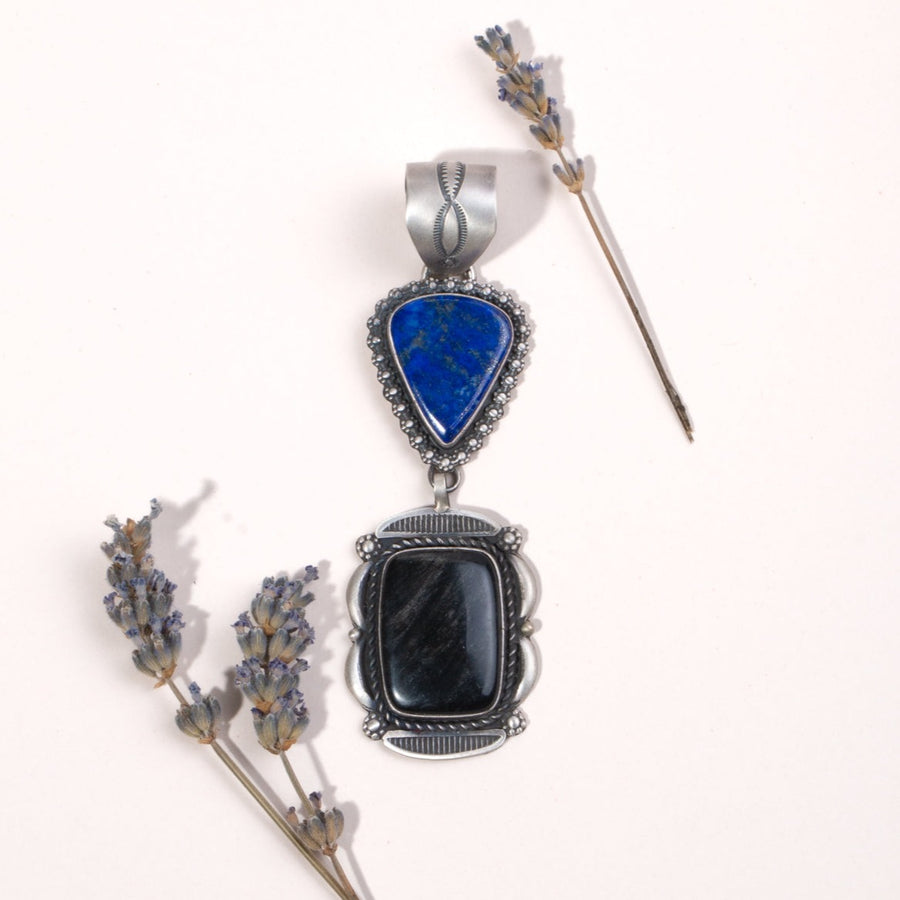
Branson described “very distinctive deep blue gems,” the dark brown to black matrix set against deep blue and greenish-blue. [1]
He was also plain about its flaw:
“Some of the turquoise is slightly honeycombed, leaving holes and pits in the stones, which necessitates the use of a plastic filler.”
— Branson (1975), p. 50 [1]
Schiffer’s 2008 description says the same things: deep blue, dark brown matrix, surface pits. [3] So when you look at a Papoose stone, ask whether its pits were filled, and with what. For what our labels mean, see What Do These Confusing Turquoise Terms Mean?
What the record doesn’t hold
Our books say nothing about the Papoose after the 1970s. The web disagrees with itself. One dealer counts the “Blue Diamond/Papoose areas” among those near Austin “still producing some material”; [9] a gallery calls it “a small legacy Nevada mine (no longer producing).” [10] Neither page is dated. No source we’ve read names who holds the Papoose claim now.
Field Notes by Mateo James
A dark matrix running through deep blue is what the eye reaches for first. What makes the Papoose worth knowing is everything around the stone. Eighty-six hundred feet. A climb Bruce Woods ranked worse than the Nevada Blue. A season that ended with the deep snow. Ninety pounds in three days was decent, and when the market dropped it still didn’t pay. A piece sold under this name came out of a short summer and a hard climb. Look at the pits, and ask what fills them.
How this page is sourced. Printed works are cited by page and describe conditions as of their dates. Web sources are cited with the date we read them; dealer pages are single witnesses, and we say so where they stand alone. If you know better, contact us.
Sources
- Branson, Oscar T. Turquoise: The Gem of the Centuries. Santa Fe: Treasure Chest Publications, 1975, p. 50. Statements describe conditions as of 1975.
- Ryan, Mike, II, and Philip Chambless. Turquoise in America, Part Two: 1910–1990. Callais Press, 2020, pp. 193–194.
- Schiffer, Nancy N. Turquoise Jewelry. Revised 4th ed. Atglen, PA: Schiffer Publishing, 2008, p. 12. Statements describe conditions as of 2008.
- Nevada Outback Gems, “Turquoise Mines of Nevada,” Austin – Turquoise entry. http://nevada-outback-gems.com/Nevada_turq_mines/turquoise_mines_of_nevada.htm. Read 9 October 2026.
- Durango Silver Co., “Nevada Turquoise Mines M–Q,” Papoose entry. https://www.durangosilver.com/NevadaturqM.htm. Read 9 October 2026.
- U.S. Geological Survey, Mineral Resource Data System, “Papoose Claim,” deposit 10270861 (reported by D. A. Lipton, U.S. Bureau of Mines, May 2, 1995). https://mrdata.usgs.gov/mrds/show-mrds.php?dep_id=10270861. Read 9 October 2026.
- U.S. Geological Survey, Mineral Resource Data System, “Zuni Claim,” deposit 10295292. https://mrdata.usgs.gov/mrds/show-mrds.php?dep_id=10295292. Read 9 October 2026.
- Morrissey, Frank R. Turquoise Deposits of Nevada. Nevada Bureau of Mines Report 17, 1968. https://pubs.nbmg.unr.edu/Turquoise_deposits_of_NV_p/r017.htm. Read 9 October 2026.
- Nevada Outback Gems, “History and Origins of Nevada Turquoise.” http://nevada-outback-gems.com/about_nv_turquoise/About_Nev_Turquoise.htm. Read 9 October 2026.
- Raven Makes Gallery, “Nevada Papoose/Zuni Mine Turquoise and Silver Bolo Tie, by Ivan Howard.” https://www.ravenmakesgallery.com/products/pilot-mountain-turquoise-and-silver-ring-by-ivan-howard. Read 9 October 2026. Archived copy, 9 October 2026: https://web.archive.org/web/20261009192756/https://www.ravenmakesgallery.com/products/pilot-mountain-turquoise-and-silver-ring-by-ivan-howard.