



Tommy Singer — Navajo/Diné Silversmith & His Hallmarks

Thomas Singer's hallmark as photographed on an authenticated piece. © Turquoise Skies Inc.
Thomas "Tommy" Singer. b. Phoenix, AZ, 1938 (some sources say 1940) — d. May 31, 2014. The man who invented a technique the whole trade would copy.
Most silversmiths are remembered for a piece. Tommy Singer is remembered for a method. Working out of Winslow through the 1960s and '70s, he developed chip inlay — and did it so well that within a generation it had spread across the entire Navajo silver trade, imitated by more hands than anyone could count. That's a rare kind of legacy: not a signature object, but a way of working that outran his own name.
The Marks
Singer signed prolifically and in more than one form. The best-documented are a staggered "STC" and a stylized "T. Singer" or "Thomas Singer," alongside individual T, TC, and To stamps, and — on some pieces — an S paired with a crescent moon, the crescent opening toward the letter (a form longtime collectors have confirmed as genuine). After his death in 2014, his widow, Rosita "Rose" Singer, continued the workshop under "T&R Singer," so that mark postdates Tommy's own hand.

A “T. Singer” stamp
One caution, in the interest of the collector: a straight-line "STC" (as against the known staggered version) has circulated on cast work, and as of the most recent collector discussion its status — genuine variant or later fake — remained unresolved. We flag it rather than rule on it; where the paper trail stops, we say so.
The Smith
He was Diné, born in Phoenix in 1938 (a few sources give 1940 — the record isn't perfectly clean, and we won't pretend it is), and he learned at his father's bench. His father, Tsinnigine Hathali, a Navajo medicine man, put tools in his hands at seven. There was no art school in the story — this was the reservation apprenticeship model, one generation teaching the next directly. He worked from Winslow, Arizona, for most of his career, and died there in his home country in 2014, in a motorcycle accident near Blue Gap.
The Work
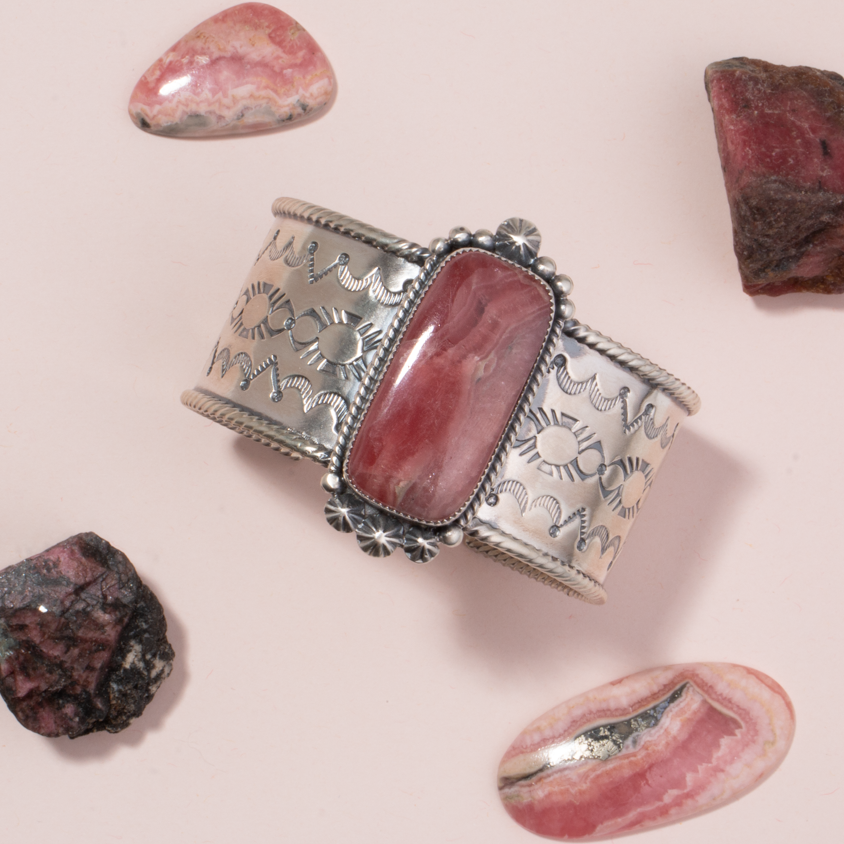
Chip inlay is the thing to understand. Where the older Zuni tradition set smooth, polished tiles of stone edge to edge, Singer set small chips of turquoise and coral into carved silver channels — a rougher, more painterly mosaic that reads as texture and color rather than precision tilework. He built it out in the 1960s and '70s, and it became one of the most widely imitated techniques in the whole industry, which is the truest measure of how good the original was. He also worked overlay and stamped silver, but chip inlay is the invention that carries his name.
The Standing
Singer's work sits in the permanent collection of the Gorman Museum at UC Davis — a cast bolo tie, held by an institution named for the Navajo painter Carl Gorman's son, R.C. Gorman, and dedicated to Native art. Retail and gallery sources widely repeat that he won "numerous Santa Fe Indian Market awards," but we could not source a specific, verifiable citation — a year, a category — so we leave it as an unconfirmed claim rather than dress it up as fact.
Know more about Tommy? Contact T.Skies.
From the Library: Turnbaugh, Indian Jewelry of the American Southwest (2007)
2007 primary source. Anything described as current here describes 2007, not today.
Turnbaugh (2007) named him among the first chip inlay makers:
“Chip inlay work was first made in the early 1960's by Navajo smiths including Dean Kirk, Tom Singer, and other Singer family members.”
— Turnbaugh (2007), p. 45 [1]
Other sources record Dean Kirk as a trader (Hougart 2022, p. 363; Bahti 2007, p. 70).
From the Library: Jacka, Navajo Jewelry: A Legacy of Silver and Stone (1995)
1995 primary source. Anything described as current here describes 1995, not today.
These are an outside writer’s records from 1995 and the artists’ own words as she recorded them; the Diné themselves are the authority on their own beliefs and practices.
Tommy Singer told Jacka (1995, p. 37) that he opened a shop in Shiprock in 1968 and worked first in overlay, then in chip inlay. [2]
Singer described the discovery to Jacka in 1995:
“As I was cutting stones one day, I noticed all these little chips, pieces of good turquoise stones left over. I tried gluing these scraps together, epoxying them, then grinding off the tops, and polishing them.”
— Jacka (1995), p. 37 [2]
Jacka (1995) on what his designs showed:
“Those that seemed to resemble the meaningless tepee and thunderbird designs of the forties actually are symbols of the Native American Church, a religion that combines traditional Navajo rituals and the use of peyote with Christian precepts.”
— Jacka (1995), p. 37 [2]
Troubled by copies of his work that buyers took for his own, Singer told Jacka (1995, p. 37) that he went back to traditional work in the 1980s, while some of his brothers kept making the style. [2]
In 1995 Tommy Singer told Jacka he used only old designs:
“They are traditional designs that go with the songs, ceremonies, and prayers.”
— Jacka (1995), p. 105 [2]
From the Library: Baxter, Encyclopedia of Native American Jewelry (2000)
2000 primary source. Anything described as current here describes 2000, not today.
In her 2000 encyclopedia, Baxter wrote of story jewelry:
“Three contemporary artists who have gathered acclaim for their story imagery on jewelry are Vidal Aragon (Santo Domingo), Clarence Lee (b. 1952; Navajo), and Thomas (Tommy) Singer (Navajo).”
— Baxter (2000), p. 168 [6]
From the Library: Schaaf, American Indian Jewelry I (2003)
2003 primary source. Anything described as current here describes 2003, not today.
Schaaf (2003, p. 195) recorded that Nelson Lewis, Sr., a cousin of the Navajo smith Howard Johns (1928-1963), credited Howard with innovating chip inlay, and that after Howard's death his tools went to Tommy Singer. [7]
Schaaf (2003) wrote:
“Howard's tools went to Tommy Singer, who became one of the most famous Navajo jewelers”
— Schaaf (2003), p. 195 [7]
Schaaf (2003), in the entry for his relative Nelson Lewis, Sr., wrote that Tommy Singer
“later popularized the technique”
— Schaaf (2003), p. 215 [7]
Schaaf (2003) recorded his marks:
“encircled T & crescent moon hallmark; T. Singer, Thomas Singer”
— Schaaf (2003), p. 291 [7]
Schaaf (2003, p. 291) recorded Tommy Singer as Navajo, born about 1940, living at Dilkon and Winslow, the husband of Rose Singer and uncle of Lula Begay. [7]
Tommy Singer told Schaaf (2003):
“My father was a silversmith. He taught me and wanted me to continue this trade.”
— Schaaf (2003), p. 292 [7]
Schaaf's 2003 hallmark index gives TS to one maker:
“TS (Tommy Singer)”
— Schaaf (2003), p. 276 [7]
Field Notes by Mateo James
This page credits Tommy Singer with developing chip inlay. The Turnbaughs agree on the decade, the early 1960s, but they list him with Dean Kirk and other members of the Singer family rather than alone. I have kept both versions visible.
I notice Tommy Singer's own account, as Lois Essary Jacka recorded it in 1995, puts his shop in Shiprock in 1968 and his chip inlay after a period of overlay. This page places him in Winslow through the 1960s and '70s, and Turnbaugh (2007) dates the first chip inlay to the early 1960s. I have left each account as printed.
I notice a second account of how chip inlay began. This page credits Tommy Singer, and Turnbaugh names him among the first chip inlay makers, while Schaaf's 2003 register records Howard Johns's cousin as saying Howard was the innovator and that Howard's tools later went to Tommy. Both accounts are shown as printed.
Sources
- Turnbaugh, William A., and Sarah Peabody Turnbaugh. Indian Jewelry of the American Southwest. Foreword by Barry M. Goldwater. Atglen, PA: Schiffer Publishing, 2007 (copyright 1996 and 2007; first published 1988). ISBN 0-7643-2577-9. Cited by printed page. Statements describe conditions as of 2007.
- Jacka, Lois Essary. Navajo Jewelry: A Legacy of Silver and Stone. Photographs by Jerry Jacka. Flagstaff: Northland Publishing, 1995. Cited by printed page. Statements describe conditions as of 1995.
- Mateo’s notes, July 2026 — compiled from Schaaf, American Indian Jewelry III; the Gorman Museum collection record; and a Turquoise People collector forum thread (Nov 2019) on mark authentication.
- Gorman Museum, UC Davis — Tommy Singer cast bolo tie (permanent collection) — permanent collection record.
- Hougart, Bille. Native American and Southwestern Silver Hallmarks, 5th ed. Washington, DC: BilleHougartBooks, 2022.
- Baxter, Paula A., with Allison Bird-Romero. Encyclopedia of Native American Jewelry: A Guide to History, People, and Terms. Phoenix: Oryx Press, 2000. Cited by printed page. Statements describe conditions as of 2000.
- Schaaf, Gregory, with Angie Yan Schaaf. American Indian Jewelry I: 1,200 Artist Biographies, ca. 1800-present. American Indian Art Series, Vol. 5. Santa Fe: CIAC Press, 2003. Cited by printed page. Statements describe conditions as of 2003.
This profile is maintained in support of Native American silversmiths and compiled from published references. See something inaccurate, or want to add to it? Contact us.