



Michael Kabotie — Hopi Silversmith, "Lomawywesa" & His Mark
Michael Kabotie, 1942–2009. Shungopavi, Second Mesa. The painter's son who added a third layer to Hopi overlay.
Michael Kabotie was born into the tradition at its source: his father, Fred Kabotie, was the pre-eminent Hopi painter of his generation and one of the two men who co-developed Hopi silver overlay itself in the postwar Guild. Most sons of a master inherit the method and keep it. Michael took the two-layer overlay his father helped invent and built a third layer onto it — a technique galleries call his "triple-overlay," raising the work off the metal into something closer to sculpture. As the College Art Association put it, he "modified Hopi overlay into three-dimensional pieces, a process most Hopi jewelers would never attempt." He was a painter and a poet who treated silver like a canvas with depth.
The Smith
He was born September 3, 1942, at Shungopavi, on Second Mesa, into the Snow Clan, son of Fred Kabotie and Alice, a basket weaver. His Hopi name is Lomawywesa. Wright lists him as “Michael Kabotie-Lomawywesa,” with a cursive signature mark dated 1979 (Wright 2003, p. 83), and Bassman credits a bola tie to “Lomawywesa (Michael Kabotie)” (Bassman 1993, p. 17). [1] [2]
He learned overlay as a teenager, from his father and from the Hotevilla silversmith Wallie Sekayumptewa. But the mentor who set his direction was the Cochiti/San Ildefonso painter Joe Herrera, whom he met at a summer art program and who introduced him to the ancient Awatovi kiva murals — the imagery that would drive both his canvases and his silver for the rest of his life. After a 1966 solo show at the Heard Museum launched his painting career, he left an engineering program to make art full time. In 1973 he co-founded Artist Hopid, a five-member collective reinterpreting Hopi art in contemporary forms, published a book of poems, and for twenty-six years — from 1983 until his death in 2009 — taught Hopi silversmithing at Idyllwild Arts in California.
The Work
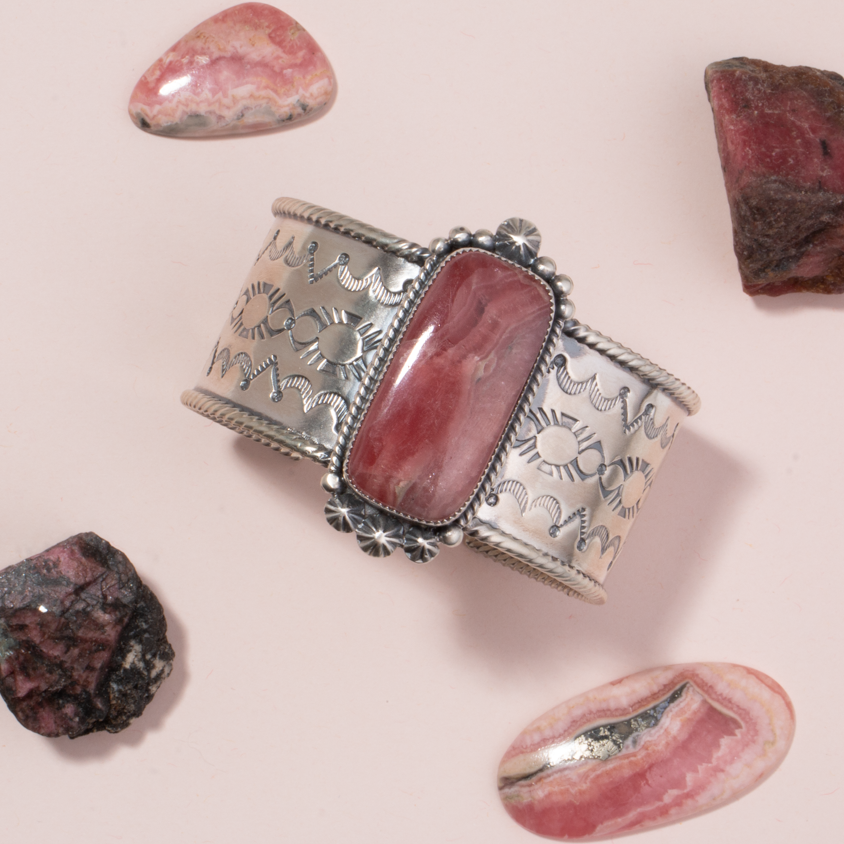
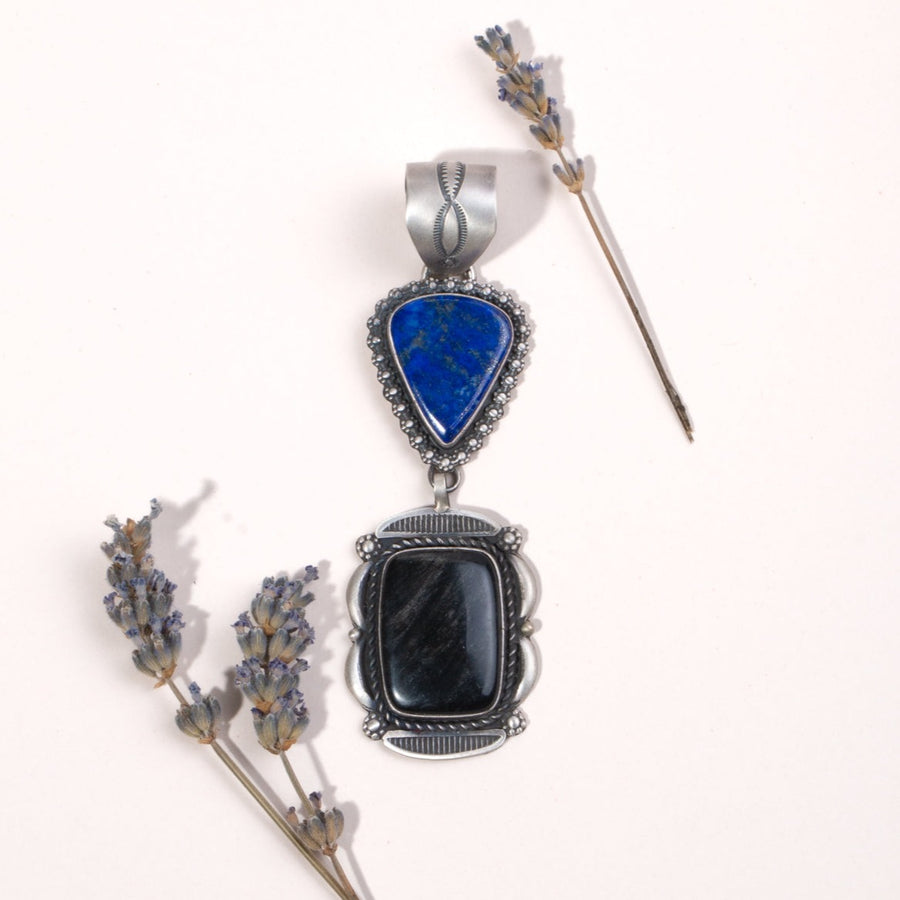
Standard Hopi overlay is two sheets of silver: a design sawn from the top layer, the recessed layer beneath it oxidized dark. Kabotie's triple-overlay adds a third worked layer, and with stampwork, chisel, etching, and cut-out tapered panels he pushed it toward the sculptural — one 2001 bracelet was built "like a box, squared and hollow, an astounding construction feat." His design vocabulary came straight off his painting: motifs from the Awatovi kiva murals and Sikyatki pottery, clouds and rain and the San Francisco Peaks. Critics reached for Picasso and Braque to describe the cubist energy of it; Kabotie said he'd never heard of them when his style formed, and pointed instead to his ancestral Puebloan sources.
Some of that work draws directly on katsina imagery and Hopi cosmology — the San Francisco Peaks as the home of the katsina spirit beings — as his own acknowledged subject matter. We describe these as he and his galleries and museums have publicly; the ceremonial meaning behind them belongs to the Hopi people.
The Mark
Kabotie signed his silver with his Hopi name, "Lomawywesa," in a cursive hand — the same name he signed his paintings with (documented by Fine Arts of the Southwest on individual pieces). Collectors should know he used more than one mark over his career; a shorthand initial mark is also documented, so the cursive "Lomawywesa" is not the only signature you'll find on his work.
The Standing
Kabotie's work is held in the permanent collection of the Heard Museum (which named him a Signature Artist in 2010, and whose Berlin Gallery gate he designed in the style of his overlay), and his monumental silver installation, the "Silver Room of Awatovi," traveled in the American Museum of Natural History's exhibition Totems to Turquoise. He designed the front gate of the Museum of Northern Arizona, co-painted major murals there, lectured internationally, and was named an Arizona Indian Living Treasure. He showed at Santa Fe Indian Market through the 1980s and 1990s, and his line runs on through a large family of artists.
Know more about Michael? Contact T.Skies.
- Pardue, Diana F. Contemporary Southwestern Jewelry + Bahti, Mark. Silver + Stone.
- Michael Kabotie — Wikipedia
- Michael Kabotie: In Memoriam — College Art Association
- Michael Kabotie — Museum of Northern Arizona
- Michael Kabotie triple-overlay ring — Fine Arts of the Southwest
- Remembering the Future: 100 Years — Heard Museum
From the Library: Wright, Hopi Silver (2003)
2003 primary source. Anything described as current here describes 2003, not today.
Wright (2003) recorded where he picked up the craft:
“Michael learned to work silver by loitering around the guild workshop where Wally Sekayumptewa helped him.”
— Wright (2003), p. 68 [1]
According to Wright (2003, p. 68), he later worked alone while earning his college degree and gaining recognition as a painter, and his layered silver used the angular circular elements of his painting style, reminiscent of the Awatovi murals, with clouds, rain, the bear and kachinas that were personal to him. [1]
According to Wright (2003, p. 83), Michael Kabotie-Lomawywesa, of the Snow clan at Shungopavi, began silverwork in 1967, was self-taught with help from Wally Sekayumptewa, and did little work until 1979; the signature mark shown in his row is dated 1979. [1]
From the Library: Bassman, The Beauty of Hopi Jewelry (1993)
1993 primary source. Anything described as current here describes 1993, not today.
Bassman (1993, p. 17) pictured a bola tie with a lightning, rain and clouds design and a coral stone, with a matching belt buckle, made in 1992 by Lomawywesa (Michael Kabotie). [2]
From the Library: Schaaf, American Indian Jewelry I (2003)
2003 primary source. Anything described as current here describes 2003, not today.
Schaaf (2003, p. 200) recorded Michael Kabotie as Hopi, active from about 1967 in painting, murals, graphics and overlay, tufa-cast and set stone jewelry, a son of Fred and Alice Kabotie, taught by his father and by Wally Sekayumptewa, showing at Indian Market from 1982 with prizes there in 1984, and with his work in the British Museum in London. [3]
Schaaf (2003) wrote of his overlay:
“Kabotie carries their style forward with Hopi design elements.”
— Schaaf (2003), p. 200 [3]
Schaaf's 2003 hallmark index gives MK to two makers:
“MK (Michael Kabotie, Melinda Koinva)”
— Schaaf (2003), p. 199 [3]
Field Notes by Mateo James
Field Notes by Mateo James: This page says Michael learned overlay as a teenager from his father and from Wallie Sekayumptewa. Wright's listing calls him self-taught with help from Sekayumptewa, and gives 1967 as the year he began. I show both accounts.
I notice the books read his style differently. This page reports that Michael said he had never heard of Picasso or Braque when his style formed, while Schaaf's 2003 entry says some of his work shows an influence from Cubism. I show both, and give his own account first.
Sources
- Wright, Margaret Nickelson. Hopi Silver: The History and Hallmarks of Hopi Silversmithing. Revised edition. Albuquerque: University of New Mexico Press, 2003. Originally published by Northland Publishing. Cited by printed page. Statements describe conditions as of 2003.
- Bassman, Theda. The Beauty of Hopi Jewelry. Photography by Gene Balzer. Walnut, California: Kiva Publishing, 1993. Cited by printed page. Statements describe conditions as of 1993.
- Schaaf, Gregory, with Angie Yan Schaaf. American Indian Jewelry I: 1,200 Artist Biographies, ca. 1800-present. American Indian Art Series, Vol. 5. Santa Fe: CIAC Press, 2003. Cited by printed page. Statements describe conditions as of 2003.
This profile is maintained in support of Native American silversmiths and compiled from published references. See something inaccurate, or want to add to it? Contact us.