



Orville Tsinnie — Navajo/Diné Silversmith & His Mark
Orville Z. Tsinnie, 1943–2017. Shiprock, New Mexico. The lawman who picked up the tools at twenty-seven — and never put them down.
Orville Tsinnie didn't come up through the great Navajo silversmithing lineage. He came up through the Navajo Nation's personnel office and the Navajo Police Department. He was twenty-seven, visiting his sister and her husband — a Hopi silversmith — when he sat down with a set of tools that happened to be there and made his first piece. That was the whole beginning. From that afternoon, with no formal training, he built himself into one of the most respected silversmiths on the Navajo Nation — and in 1999 the Indian Arts and Crafts Association gave him its Lifetime Achievement Award, an honor it reserves for the very top of the field.
The Smith
He was born September 30, 1943, in Tuba City, and he lived and worked most of his life in Shiprock, in the shadow of the great rock formation the Diné call Tsé Bit'a'í. His mother, Ann Yellowhorse, was a jeweler who worked in set stones and leaf appliqué (Hougart 2022, p. 348). [3] His entry into the craft came through his brother-in-law, the Hopi silversmith Horace Emerson — but Tsinnie quickly turned away from the Hopi inlay style he first saw and set himself toward something else entirely. He wanted, in his own words, "pure Navajo, simple 1900's style, bold, clean, solid." He ran a home studio and gallery in Shiprock with his wife, Darlene Tsinnie, a well-known jeweler in her own right — the two often shared the same stamps and worked side by side. Alongside the silver, he carved katsina dolls.
The Work
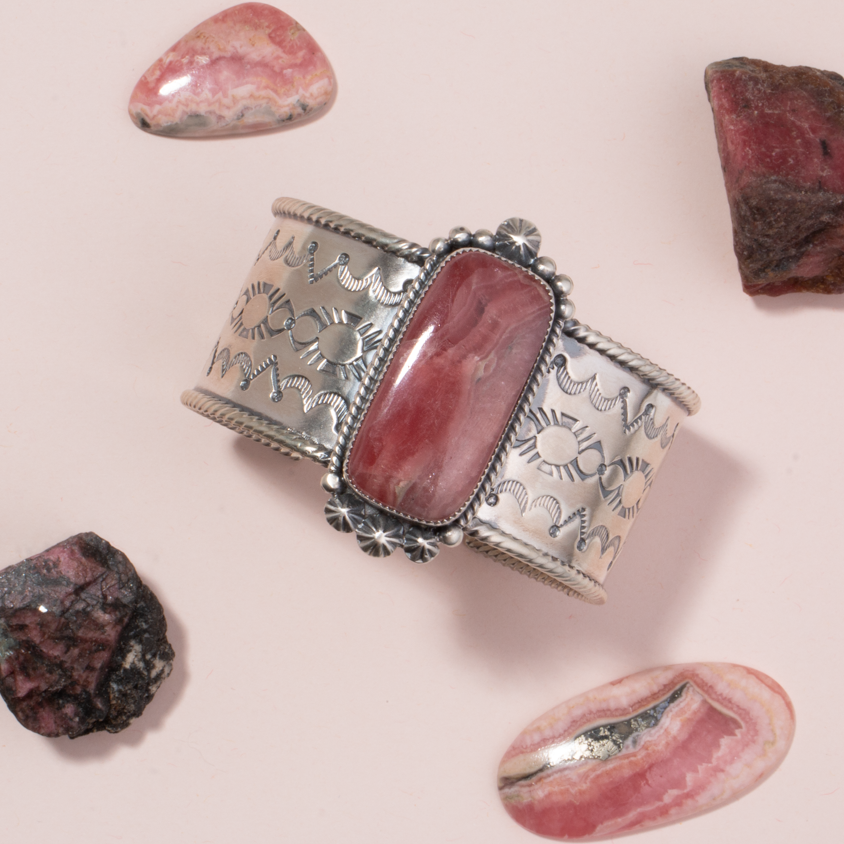
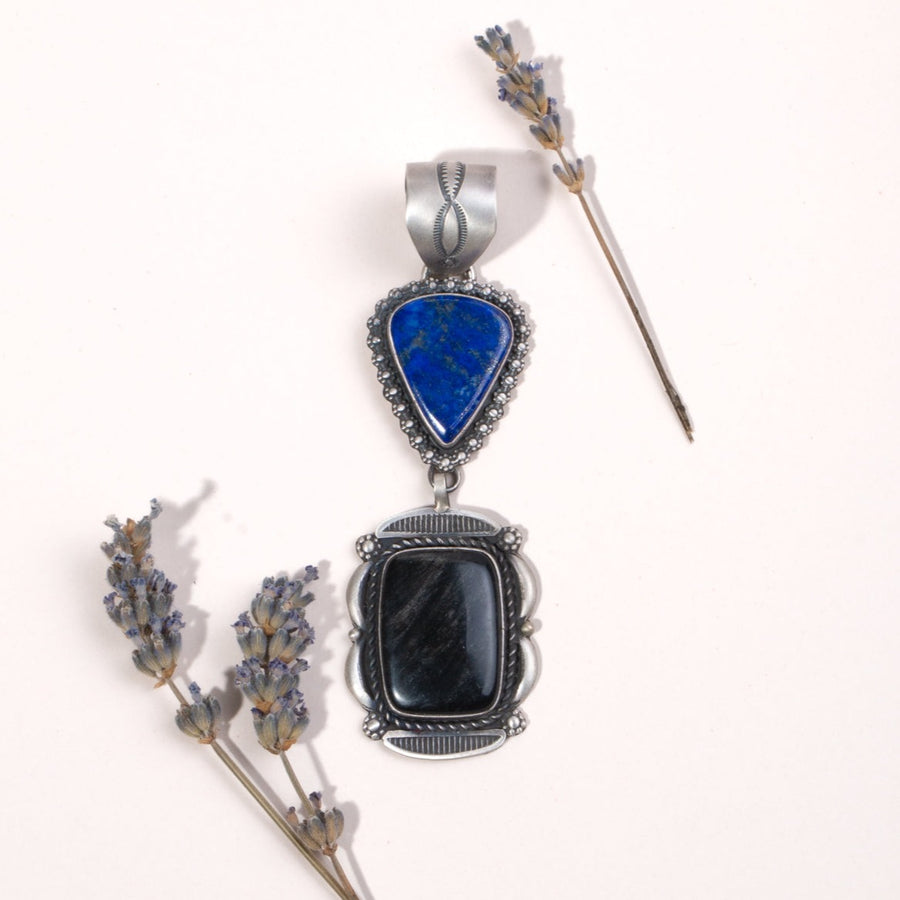
Tsinnie's signature is weight and stamp. He worked heavy-gauge sterling, hand-fabricated rather than cast, and covered it in dense, precise, large-scale stampwork — bold lines and deep-struck patterns that read as unmistakably his. He was a perfectionist about stone, hand-picking and polishing only top-grade naturals: Morenci turquoise early on, later lapis, sugilite, jasper, obsidian, coral, and a material he prized above most — fossilized dinosaur bone. Nothing about the work is fussy or ornamental for its own sake. It's the "bold, clean, solid" idiom he set out to make, held to for a lifetime.
The Mark
His hallmark is his home. Tsinnie stamped his pieces with the silhouette of the Shiprock formation — sometimes twice — alongside his name, "New Mexico," and "Sterling." The man and the mark were rooted in the same ground. One note for collectors: because he and Darlene shared stamps, a Shiprock-marked piece can't always be assigned to one hand over the other on the mark alone.
The Standing
Beyond the 1999 IACA Lifetime Achievement Award — and a separate IACA Artist of the Year honor — Tsinnie took first place at the 37th Navajo Craftsman Exhibition at the Museum of Northern Arizona in 1986, and his work entered the permanent collection of the Smithsonian's National Museum of the American Indian (a bracelet, a necklace, and a belt buckle among the pieces held there). Schaaf (2003, p. 311) lists Santa Fe Indian Market awards for him from 1976 through 2000. [2] He died in Shiprock on May 23, 2017, at seventy-three.
Know more about Orville? Contact T.Skies.
- Pardue, Diana F. Contemporary Southwestern Jewelry + Bahti, Mark. Silver + Stone.
- Orville Tsinnie — Wikipedia
- Orville Tsinnie, Diné Silversmith (hallmark photos) — Adobe Gallery
- About Orville Tsinnie — Sacred Stone Gallery
- Remembering Orville Tsinnie — Toh-Atin Gallery
- Orville Tsinnie obituary (1943–2017) — Farmington Daily Times / Legacy.com
From the Library: Bahti, Silver + Stone: Profiles of American Indian Jewelers (2007)
2007 primary source. Anything described as current here describes 2007, not today.
Speaking to Bahti (2007), Orville Tsinnie recalled his first piece, made from a scrap of silver his sister handed him:
“The first thing that came to my mind was overlay because he [the brother-in-law] was doing overlay.”
— Bahti (2007), p. 180 [1]
As Orville Tsinnie told Bahti (2007) about teaching himself at home:
“It's all a matter of being able to work the metal the way you want, and my welding experience helped.”
— Bahti (2007), p. 180 [1]
According to Bahti (2007, p. 180), Tsinnie first worked metal on his father's welding machine as a boy, moved to Shiprock in 1972, and left his job at the Navajo Engineering and Construction Authority in 1973 to become a full-time silversmith. [1]
Tsinnie told Bahti (2007) that the traders he sold to, including Bob French of Waterflow Trading and Sue and Russell Adams, urged an older style and opened their vaults to him:
“They would let me go into their walk-in vaults where I could see old stuff they had.”
— Bahti (2007), p. 181 [1]
According to Bahti (2007, p. 182), Tsinnie's first hallmark was based on his family's livestock brand, OZT arranged vertically; he then settled on his last name in block letters, and within about a year used "Orville and Darlene." About 1980 he began stamping "Orville Tsinnie of New Mexico" with two little Shiprocks, which as of 2007 he still used on smaller pieces, with "Orville Tsinnie, Shiprock, New Mexico" on larger pieces and every concha stamped on most belts. [1]
From the Library: Schaaf, American Indian Jewelry I (2003)
2003 primary source. Anything described as current here describes 2003, not today.
Schaaf (2003) entered him as
“Orville Tsinnie (stamps ODT, hallmark - Shiprock with his name in print or script), (collaborates with Darlene Tsinnie)”
— Schaaf (2003), p. 311 [2]
Schaaf (2003, p. 311) recorded Orville Tsinnie's Indian Market prizes from a second for concha belts in 1976 through the Squash Blossom Necklace Award in 1986 and 1990. [2]
Schaaf's 2003 hallmark index gives ODT to the couple:
“ODT (Orville & Darlene Tsinnie)”
— Schaaf (2003), p. 297 [2]
Field Notes by Mateo James
An earlier version of this page dropped the line naming Orville's mother because Bahti (2007, p. 180) does not name her; the Ann in his account there is Ann Yellowstone, his wife's grandmother. Hougart (2022, p. 348) does name his mother: Ann Yellowhorse, a Navajo jeweler. The line is back, with that credit. [1] [3]
Sources
- Bahti, Mark. Silver + Stone: Profiles of American Indian Jewelers. Tucson: Rio Nuevo Publishers, 2007. Cited by printed page. Statements describe conditions as of 2007.
- Schaaf, Gregory, with Angie Yan Schaaf. American Indian Jewelry I: 1,200 Artist Biographies, ca. 1800-present. American Indian Art Series, Vol. 5. Santa Fe: CIAC Press, 2003. Cited by printed page. Statements describe conditions as of 2003.
- Hougart, Bille. Native American and Southwestern Silver Hallmarks: Silversmiths, Designers, Guilds and Traders. 5th edition. Washington, DC: BilleHougartBooks, 2022.
This profile is maintained in support of Native American silversmiths and compiled from published references. See something inaccurate, or want to add to it? Contact us.