



Allen Kee — Navajo/Diné Silversmith & His Hallmarks
Allen Kee. Navajo (Diné), 1916–1972. Kenneth Begay's cousin, and one of the two hands the White Hogan was built on.
Every famous shop has a name over the door and the hands that actually built its reputation. At Scottsdale's White Hogan — the shop that did as much as any to carry Navajo silver into the modern era — one of those hands belonged to Allen Kee. He was there at the start, one of its two original silversmiths, and he made most of the molds the shop's cast silver was poured from. Much of what collectors know as the White Hogan look began as a form Allen Kee carved.
The Marks
Kee's work carries a conjoined "AK" alongside the White Hogan's own domed-hogan shop stamp and "HAND MADE STERLING." The pairing matters for the collector: the shop mark places the piece at the White Hogan, and the "AK" identifies the hand — a two-part signature typical of the shop-and-smith system that governed White Hogan output.
The Smith
He was born in 1916, first cousin to Kenneth Begay — the man widely called the father of modern Navajo silverwork — and the two worked the same shop at the same formative moment. Kee was one of the two original silversmiths at the White Hogan (the Bonnell family's Scottsdale shop), and the shop's own history credits him specifically with cutting most of its sand-cast molds — the master forms that gave the White Hogan its consistent, architectural line. To make the molds is to set the shape of everything cast from them; Kee's influence runs through pieces that never carried his mark.
The Work
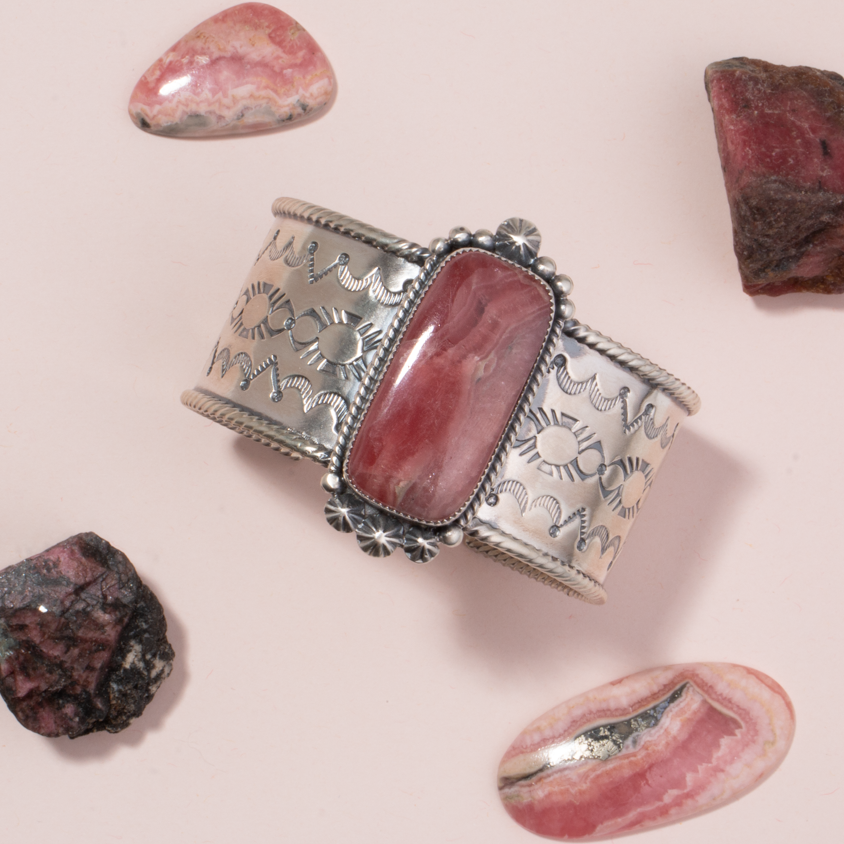
Kee worked in sand-casting and favored structured cuffs — split-shank and multi-bar forms with the clean, weighted geometry the White Hogan became known for. With his brother George Kee and his cousin Kenneth Begay, he is credited with developing the "five-bar bracelet," a design that reads as pure structure: parallel bars of silver held in balance, no ornament doing the work that form should. It is of a piece with the whole White Hogan project — modern, restrained, built rather than decorated.
The Standing
Kee's standing rests on the White Hogan itself: to be one of its two founding smiths, and the maker of its molds, is to sit near the source of modern Navajo silver's most influential shop. (One dealer lists a LACMA holding; a direct search of the museum's own collection returned nothing under his name, so we leave that claim out rather than repeat it unverified.) His clearest monument is the shop's body of work — and the cousin, Kenneth Begay, whose name the era remembers and whose bench Kee shared.
Know more about Allen? Contact T.Skies.
- Mateo’s notes, July 2026 — White Hogan shop history (crediting Kee with most of the shop's sand-cast molds, as one of two original smiths); conjoined-AK + shop-stamp hallmark record.
- Cross-reference: Kenneth Begay — his first cousin and White Hogan benchmate; father of modern Navajo silverwork.
- Omitted: a dealer's LACMA-holding claim — direct search of LACMA's collection returned zero results; not published without verification (§5 transparency).
From the Library: Stacey, Turquoise Blue Book and Indian Jewelry Digest (1975)
1975 primary source. Anything described as current here describes 1975, not today.
The 1975 Turquoise Blue Book on the White Hogan in the late 1950s:
“The photographs on these pages were taken in the White Hogan, Scottsdale, during the late 1950's where Navajo grand masters Kenneth Begay and the late Allen Kee produced more award winning classics than any other”
— Stacey (1975), p. 50 [1]
From the Library: Schaaf, American Indian Jewelry I (2003)
2003 primary source. Anything described as current here describes 2003, not today.
Schaaf (2003, p. 203) recorded Allen Kee as Navajo, of Steamboat Springs, a cousin of Kenneth Begay, taught by Ambrose Roanhorse and Kenneth Begay, and a smith for the White Hogan from 1946 to 1962, where he worked with Sam Roanhorse and Kenneth Begay. [2]
Schaaf (2003), drawing on Baxter, wrote of the White Hogan's founders:
“They offered Allen and Kenneth a regular salary and a percentage of the company profits.”
— Schaaf (2003), p. 203 [2]
Schaaf (2003, p. 203) listed the Los Angeles County Museum of Art among the collections holding his work. [2]
Schaaf's 2003 hallmark index gives AK to him alone:
“AK (Allen Kee)”
— Schaaf (2003), p. 199 [2]
Schaaf (2003, p. 272) named Allen Kee among the students of the Navajo smith Ambrose Roanhorse, with Lewis Lomay and the students of the Santa Fe Indian School. [2]
Field Notes by Mateo James
I notice this page left out a LACMA holding because the museum's own search showed nothing under his name. Schaaf's 2003 register does list the Los Angeles County Museum of Art among his collections, so I now show that as Schaaf's record, beside the earlier note that the museum's online search did not find it.
Sources
- Stacey, Joseph, ed. Turquoise Blue Book and Indian Jewelry Digest. Arizona Highways Collectors Series. Phoenix: Arizona Highways (Arizona Department of Transportation), 1975. Cited by printed page. Statements describe conditions as of 1975.
- Schaaf, Gregory, with Angie Yan Schaaf. American Indian Jewelry I: 1,200 Artist Biographies, ca. 1800-present. American Indian Art Series, Vol. 5. Santa Fe: CIAC Press, 2003. Cited by printed page. Statements describe conditions as of 2003.
This profile is maintained in support of Native American silversmiths and compiled from published references. See something inaccurate, or want to add to it? Contact us.