


Native American Coral
The Use of Coral in Native American Jewelry
In April 1881 an Army officer, Lt. J. G. Bourke, visited the Navajo Agency at Fort Defiance. In his journal he wrote that Navajo silver necklaces “contest the supremacy of their affections with chalchiuitl and red coral, the latter brought into the country during the Mexican domination.”[4]

People have worn coral for a very long time. The Italian coral expert Basilio Liverino wrote that its use for adornment “dates back over ten thousand years,” with fragments found in neolithic graves in Europe and among the possessions of the Minoan-Mycenean, Babylonian and Egyptian civilizations.[1]
In the Southwest, coral is an import, and the sources disagree on when it arrived. Joe Ben Wheat wrote in 1975 that “coral and glass trade beads were brought by the Spanish at least by 1750.”[2] Clara Lee Tanner, writing in 1954, dated it later: coral “does not appear until early in the 19th century, an import from Italy,” which she thought likely came to the Southwest through American traders.[3] Tanner also offered a reason it caught on with the Navajo: “possibly because of its resemblance in color to a stone or shell long used by the Indians,” red stone and shell of the same deep tone that turn up in pre-Columbian excavations.[3]
Although coral seems rock-like, it is actually a calcium carbonate (CaCO3) skeleton produced by coral polyps: tiny marine creatures that live in rich, clean, tropical to sub-tropical shallow waters of the world’s oceans. The coral polyp that produces Blood Coral, the most valued of the corals used in jewelry and other pieces of art, forms branched skeletons reminiscent of small, red trees. The coral polyp deposits calcium carbonate, forming the skeleton that divers harvest for use in artwork.
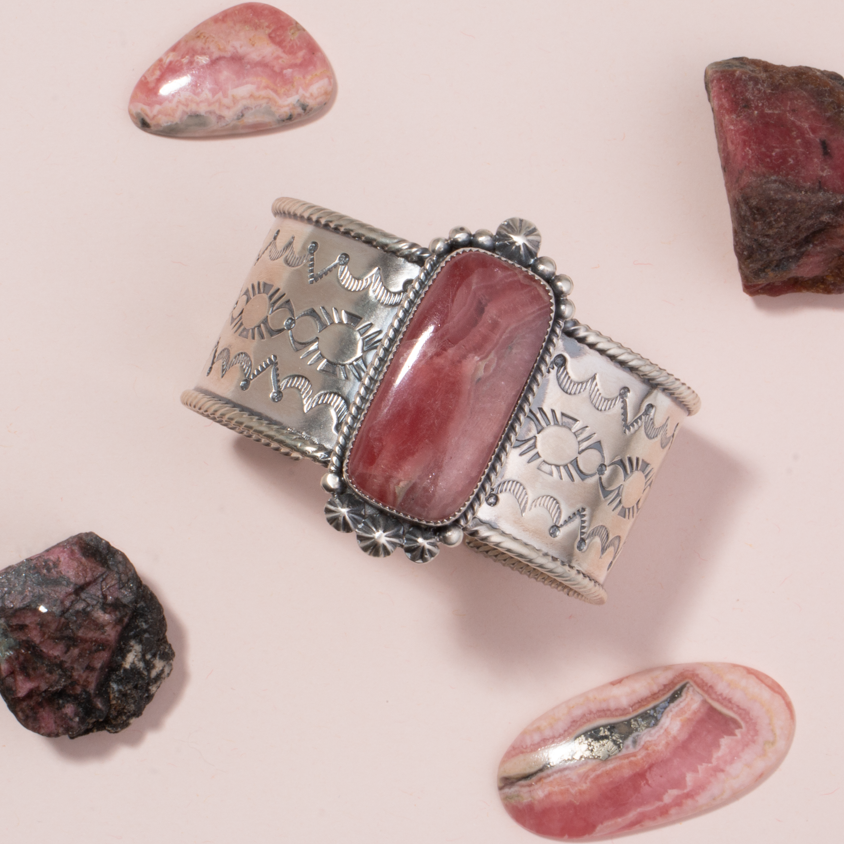
Many types of coral exist, but the red Blood Coral and pink coral draw the highest price on the market. Corals, though, come in a wide variety of colors, including blue, blush pale pink (Angel Skin Coral), rose, orange, deep red (Ox Blood Coral), black (Conchiolin), and white. The valuable orange red coral, from the Mediterranean Sea has suffered from excessive harvesting and reduced water quality. Today, the red corals come largely from Japan and Australia. Black Conchiolin comes from Hawaii.

Coral has always drawn a high price on the market, and, the early Native American market was no exception. The Native Americans often carved shells into small, disk-shaped beads called, “heishi,” and often used them as spacer beads between more the more precious stones, including coral.
Among the Navajo, coral has long been worn as wealth. In 1975, a feature on coral reported that among Navajo women, “strands of coral beads are a symbol of success and social prominence.”[1] Wheat described the early Navajo necklaces as “composed of as many strands as the owner could afford.”[2] Tanner put it more bluntly in 1954: Navajos treated silver, turquoise, shell and coral as “hard goods,” “as sound as any bank account.”[3]

The high cost of coral comes partially from the harvesting process: diving and collecting in the ocean. Hand collection is costly and has inherent risks. In addition, harvesting and other intrusions, like global warming and pollution, have threatened coral reefs. Coral has become scarcer, and coral collecting opportunities have greatly diminished. Much of the Mediterranean Blood Coral on the market today was collected prior to World War II. As these coral stocks run out, and natural populations recover slowly, if at all, coral prices continue to rise.
Today, a great deal of imitation coral, produced from plastics, glass, bone, and porcelain, have come into the market. Experts distinguish natural coral by its distinctive wood grain texture.
Contributing Author – Jeffery Bacon
From the Library: Bahti, Southwestern Indian Arts & Crafts (rev. ed.) (1989)
1989 primary source. Anything described as current here describes 1989, not today.
Bahti (1989, p. 6) wrote that coral, imported from Italy and Japan, had been used increasingly since the early 1950s. [5]
Sources
- “Coral: ‘Red Gold’ of Indian Jewelry,” excerpted for the most part from Basilio Liverino’s monograph Red Gold – Coral. In Joseph Stacey, ed., Turquoise Blue Book and Indian Jewelry Digest. Arizona Highways Collectors Series. Phoenix: Arizona Highways (Arizona Department of Transportation), 1975, p. 88.
- Wheat, Joe Ben. “‘Old Pawn.’” In Ray Manley’s Portraits & Turquoise of Southwest Indians, text by Clara Lee Tanner and Joe Ben Wheat. Tucson: Ray Manley Photography, 1975, p. 92.
- Tanner, Clara Lee. “Navajo Silver Craft.” Arizona Highways 30, no. 8 (August 1954): 25, 27.
- Woodward, Arthur. A Brief History of Navajo Silversmithing. With field notes by Richard Van Valkenburgh. Museum of Northern Arizona Bulletin 14, 2d ed. Flagstaff: Northern Arizona Society of Science and Art, December 1946 (first edition 1938), p. 61, quoting the journal of Lt. J. G. Bourke, April 1881.
- Bahti, Mark. Southwestern Indian Arts & Crafts. Revised edition, tenth printing. Las Vegas, Nevada: KC Publications, 1989 (first published 1983). Cited by printed page. Statements describe conditions as of 1989.