


What is Turquoise Chalk?
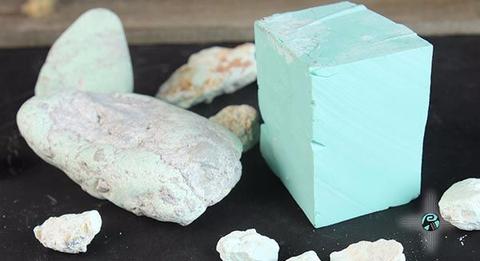
Turquoise Chalk or Chalk Turquoise is not actually chalk; it is a form of low quality natural turquoise that has the consistency of common writing chalk. Chalk turquoise is the most abundant type of turquoise found in the earth.
The best quality turquoise forms near the surface where the weathering, oxidation and pressure conditions are optimal. Chalk turquoise is usually found deeper in the earth, where it lacks the conditions to form the brilliant blue green colors and hardness we usually associate with turquoise. Chalk turquoise is usually a pale blue or green and often completely white. It is much softer compared to better quality turquoise. On the turquoise hardness on the Moh’s scale, chalk turquoise can range from a 2-3. Really good quality turquoise usually scores above 5.
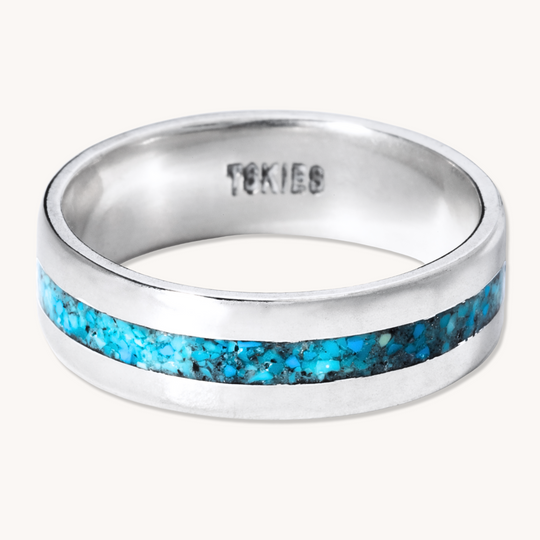
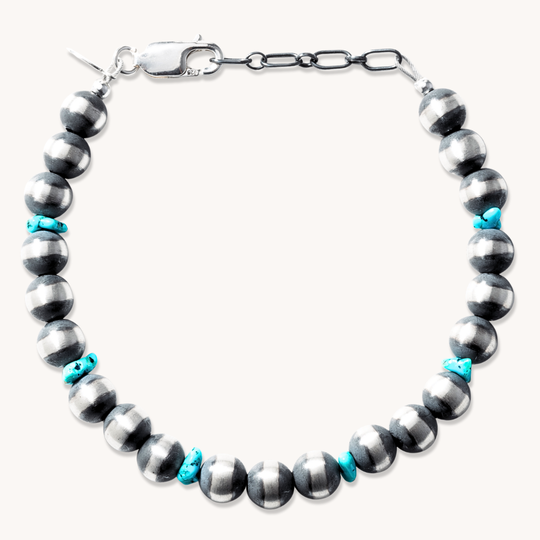
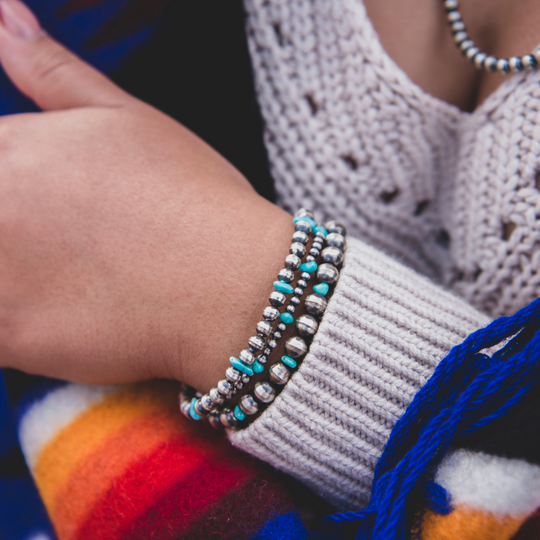
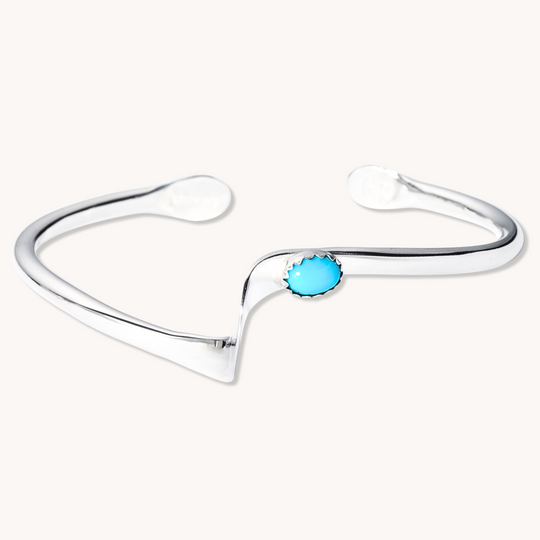
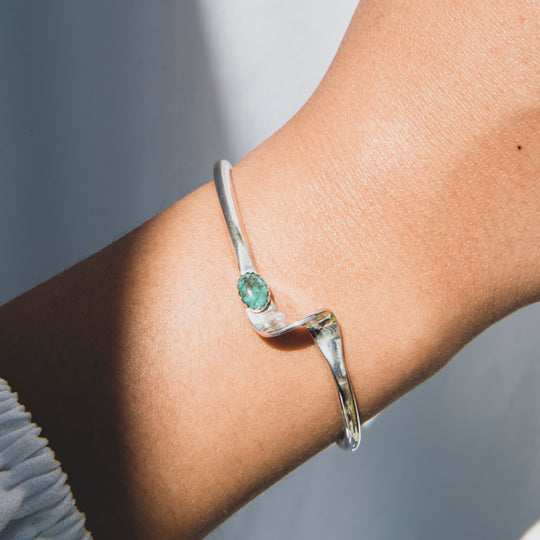
Chalk turquoise is so soft that it is not ideal for making jewelry. However, because this low grade is so accessible and people love turquoise, it is also the most common type of turquoise used in jewelry. To be usable in jewelry, chalk turquoise is crushed into a powder, infused with resins, glues and dyed making it harder and more vibrant in color. This is called reconstituted turquoise. The slabs of reconstituted turquoise are cut into cubic blocks and sold to jewelers on the market. Jewelers can then shape this plastic-like turquoise chalk block material into a desired shape, such as a jewelry cabochon. These cheap cabochons are used to make cheap jewelry.
This type of turquoise, though cheap, does have its advantages. The plastics and resins protect the material making it last longer, it allows the less fortunate to purchase a piece of turquoise jewelry when they might not otherwise be able to afford a good quality stone.
So the next time you are shopping for turquoise jewelry, keep this in mind. If a piece seems cheap, it probably is cheap because it’s made with cheap materials. If you don’t care and like how the piece looks, then you can find some great deals. If you want of find a piece with good quality turquoise, then you need purchase from a reputable dealer and don’t be afraid to ask questions about the stones. Don’t ask if the turquoise is real! Ask where the stones came from, if the stones are natural, if the stones are enhanced, if the stones are stabilized or if the stones are reconstituted.
From the Library: Pogue, The Turquois (1915)
1915 primary source. Anything described as current here describes 1915, not today.
Pogue (1915) described how turquoise behaves when exposed:
“It weathers easily when exposed, losing its color, whitening, and finally crumbling to a white powder. Many pieces with a white shell are found to be of good quality and color within.”
— Pogue (1915), p. 24
Writing in 1915, Pogue observed:
“The mineral usually shows upon the surface, and within a few feet thereof good material is often found.”
— Pogue (1915), p. 129
From the Library: Lowry, Turquoise: The World Story of a Fascinating Gemstone (2010)
2010 primary source. Anything described as current here describes 2010, not today.
Lowry (2010) described how soft chalk turquoise is:
“These formations have a similar hardness on the Mohs Scale as talc, and some can literally be used to write on a chalkboard.”
— Lowry (2010), p. 195 [2]
According to Lowry (2010, p. 195), most of this soft production is whitish or pale, and the trade calls it "chalk" or "cake" after its unusable soft form. [2]
According to Lowry (2010, p. 196), low- and medium-grade rough can look like darker high-grade stone right after mining because it is full of water, and it turns lighter as it dries out. [2]
According to Lowry (2010, p. 202), nugget and vein chalk of any shape or size can be stabilized, though not all stabilized turquoise comes out good-quality or even pretty. [2]
From the Library: Ryan & Chambless, Turquoise in America Part Two: 1910–1990 (2020)
2020 primary source. Anything described as current here describes 2020, not today.
Monty Nichols recalled, in an interview published by Ryan & Chambless (2020, p. 182), that at Sleeping Beauty all the chalk had to be treated to be useful, that roughly half of the output was treated, and that some customers wanted the treated chalk while others wanted only high-grade. [3]
Russell Twiford III told Ryan & Chambless (2020, p. 281) that chalk is the lighter, softer grade that comes out of the ground with fairly good colour, but turns light blue or blue-green and chalky once its water evaporates, and that stabilizing it created a usable product that tested as turquoise. [3]
Twiford told Ryan & Chambless (2020) that chalk had become scarce:
“Nowadays, it's hard to get a ton or two of what we call turquoise chalk”
— Ryan & Chambless (2020), p. 280 [3]
From the Library: Stacey, Turquoise Blue Book and Indian Jewelry Digest (1975)
1975 primary source. Anything described as current here describes 1975, not today.
David L. Neumann, a Santa Fe dealer whose El Palacio article the 1975 Turquoise Blue Book reprinted, on the soft grades:
“Much of the chalk-soft (oiling) turquoise went in large quantities to Idar-Oberstein in Germany. This was sold at low prices to the technicians of that town who treated it, adding color, and often cut it into spheres, the specialty of that town.”
— Stacey (1975), p. 71 [4]
From the Library: Franciscan Fathers, An Ethnologic Dictionary of the Navaho Language (1910)
1910 primary source. Anything described as current here describes 1910, not today.
These are outside observers' records from 1910; the Diné themselves are the authority on their own history and customs.
According to the Franciscan Fathers (1910, p. 68), soft turquoise, or a similar stone, was ground and mixed with water to make the blue color the Navajo used on prayersticks. [5]
Field Notes by Mateo James
I notice our article says chalk turquoise is usually found deeper, with the best stone near the surface. Pogue in 1915 described weathering working the other way: exposed turquoise loses its color, whitens and crumbles to a white powder, though a white shell can hide good stone inside. The two accounts disagree on where the white, soft material comes from.
Our article puts chalk turquoise at 2 to 3 on the Mohs scale. Lowry (2010) compares its hardness to talc's. Our article also says chalk is crushed to powder before use, while Lowry describes whole nugget and vein chalk being stabilized. I have shown both accounts here.
Sources
- Pogue, Joseph E. The Turquois: A Study of Its History, Mineralogy, Geology, Ethnology, Archaeology, Mythology, Folklore, and Technology. Memoirs of the National Academy of Sciences, Vol. XII, Part II, Third Memoir. Washington, 1915. Public domain. Cited by printed page. Statements describe conditions as of 1915.
- Lowry, Joe Dan, and Joe P. Lowry. Turquoise: The World Story of a Fascinating Gemstone. Layton, UT: Gibbs Smith, 2010. Cited by printed page. Statements describe conditions as of 2010.
- Ryan, Mike, II, and Philip Chambless. Turquoise in America, Part Two: 1910–1990. Callais Press, 2020. Cited by printed page. Statements describe conditions as of 2020.
- Stacey, Joseph, ed. Turquoise Blue Book and Indian Jewelry Digest. Arizona Highways Collectors Series. Phoenix: Arizona Highways (Arizona Department of Transportation), 1975. Cited by printed page. Statements describe conditions as of 1975.
- Franciscan Fathers. An Ethnologic Dictionary of the Navaho Language. Saint Michaels, Arizona: The Franciscan Fathers, 1910. Public domain (U.S. publication before 1931). Cited by printed page. Statements describe conditions as of 1910.