



Why Did the Stone Fall Out of My Vintage Native American Jewelry?
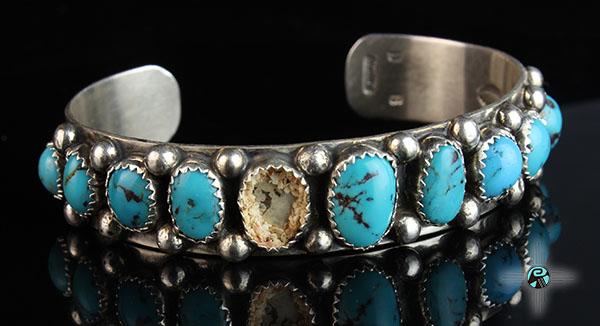
Unfortunately, stones can fall out of vintage Native American jewelry pieces. If a stone feels loose in a setting or comes out entirely, this doesn’t mean the piece is broken or defective. In fact, a loose stone is a common sign that the backing under the stone has swelled or broken down. The crafting techniques used by authentic Native artists are different than most other silversmiths, so it is important to understand how and why a stone may fall out.
In the old days, Native American silversmiths did not use any glue or epoxy to hold the stones in place. Their means to acquire quality jeweler’s epoxy were limited, so they had to make do. They found that a housing bezel such as “sawtooth” bezel does a great job of holding the stone in place, with no glue required! The little teeth of the bezel fold in and keep the stone firmly in place. However, this also means that if the bezel is disturbed (like when a bracelet cuff is flexed to fit better) the stone may come loose.

This stone was broken because its owner tried to squeeze the bracelet down to a smaller size.
If you own a piece of vintage Native jewelry, this is important to remember: Usually, the stone’s bezel is the only thing holding the stone in! This means that any adjustment to the bracelet band can open the bezel, making the stone fall out or even break! Squeezing the bracelet around the wrist may make the bracelet smaller to fit your wrist but it also puts strain on the stone and stones housing. Always make sure you have a professional make any adjustments, do NOT try to adjust vintage pieces yourself.
There is one other major reason a stone may fall out: getting the jewelry wet. Many vintage artists used sawdust to level the stone inside the bezel and behind the stone to keep it tight. This traditional method was very common among the Navajo artisans, especially. If the bracelet becomes submerged in water, the liquid will seep under the stone and because sawdust is wood it can swell and expand. This can put pressure on the stone and housing pushing the stone all the way out of the bezel! So be careful to not fully submerge any vintage Native jewelry piece, in water or cleaning solution. If you feel the need to clean a vintage piece, be careful not to get any liquids in the stone housing.

Sawdust sits inside the stone housing to keep the stones tight.
Many contemporary Native silversmiths do use epoxy to hold in stones. However, some modern artists use the classic techniques, as a way to honor the artists who came before. If you’re buying directly from an artist or a reputable dealer, ask about the stone setting.
For cleaning and everyday care, see our guide: How to Care for and Clean Native American Jewelry.
From the Library: Lund, Indian Jewelry: Fact and Fantasy (1976)
1976 primary source. Anything described as current here describes 1976, not today.
Lund (1976) on padding under the stone:
“In the case of cardboard and sawdust, contact with water will cause the materials to pack down when wet, and many people have been surprised to find that after wearing a newly purchased piece of jewelry for only a short time, the stone seems to have "shrunk".”
— Lund (1976), p. 136 [1]
According to Lund (1976, p. 122), reputable dealers of her day advised having a broken stone in an old piece mended rather than replaced, because new turquoise would not match the old stones and heat near an old setting could destroy a stone; the old repair was a strip of silver set into the crack. [1]
From the Library: Branson, Indian Jewelry Making, Vol. 1 (1977)
1977 primary source. Anything described as current here describes 1977, not today.
Branson (1977) started with the basic term:
“A bezel is the box in which a stone is mounted or set.”
— Branson (1977), p. 57 [2]
On setting, he wrote (Branson, 1977):
“The stone should be set in the bezel just high enough so the silver, when formed or crimped around the stone, will be bent over the curved sides just enough to hold the stone.”
— Branson (1977), p. 59 [2]
Branson (1977, p. 59) described padding the stone with thin cardboard, several layers if the stone was thin, to raise it to that height. [2]
For a stone that cracks in the setting, Branson (1977) gave a repair:
“When a stone is broken in a piece of jewelry it can be attractively mended by forcing the bezel away from the stone at both sides of the crack.”
— Branson (1977), p. 61 [2]
Where there were too many cracks for a silver strip, Branson (1977, p. 61) described repairing the stone with epoxy colored with a little dry color to match the matrix, then filing off the excess and lightly buffing. [2]
From the Library: Branson, Indian Jewelry Making, Vol. 2 (1979)
1979 primary source. Anything described as current here describes 1979, not today.
Branson (1979) on building an inlay bracelet:
“The inlay bracelet should be constructed entirely of heavy silver.”
— Branson (1979), p. 30 [3]
Branson (1979, p. 30) specified silver of at least 18 gauge, so the bracelet would not bend while being put on, taken off or worn. [3]
His reason (Branson, 1979):
“Since the stones are cemented securely into their channels, any movement of the silver may loosen them and cause them to come out.”
— Branson (1979), p. 30 [3]
From the Library: Bahti, Southwestern Indian Arts & Crafts (rev. ed.) (1989)
1989 primary source. Anything described as current here describes 1989, not today.
Bahti (1989, p. 48) advised putting a bracelet on from the inside of the arm, above the wrist, with a rolling motion. [4]
He explained why (Bahti, 1989):
“If it is bent each time it is put on or taken off, it will crack and may break. Bending may also crack or loosen the stones in their settings.”
— Bahti (1989), p. 48 [4]
Field Notes by Mateo James
Our post says sawdust under a stone can swell when it gets wet and push the stone out. Lund, writing in 1976, described the opposite effect: wet cardboard or sawdust packing down, so that the stone seemed to have shrunk. I record both accounts rather than choose one.
Sources
- Lund, Marsha Mayer. Indian Jewelry: Fact and Fantasy. Boulder, CO: Paladin Press, 1976. Cited by printed page. Statements describe conditions as of 1976.
- Branson, Oscar T. Indian Jewelry Making, Volume I. Tucson: Treasure Chest Publications, 1977. Cited by printed page. Statements describe conditions as of 1977.
- Branson, Oscar T. Indian Jewelry Making, Volume II. Tucson: Treasure Chest Publications, 1979. Cited by printed page. Statements describe conditions as of 1979.
- Bahti, Mark. Southwestern Indian Arts & Crafts. Revised edition, tenth printing. Las Vegas, Nevada: KC Publications, 1989 (first published 1983). Cited by printed page. Statements describe conditions as of 1989.


