


What Is Turquoise?
Turquoise Skies believes in the future of authentic, handcrafted Native American art. Our mission is to protect and preserve both the artists and the materials used to produce these treasured pieces. As a company, we believe it’s important to provide customers with accurate information on the history and culture of Native people, offer them access to skilled artists, and a way to help preserve these treasures. Along with amazing handmade jewelry available for purchase, our website is filled with intimate looks at artists at work, interviews with individuals in the industry and articles on the culture and traditions of Native people.

The evolution of our mission has come through observation of changes and challenges in the industry. Today’s Native artists face a huge threat to their work, and their income. Native American art is being outsourced to foreign countries such as China, India, and the Philippines. Sweatshops are often set up to mass produce the designs and machine make the elements. These workers receive next to nothing in pay for their work while the business owner reaps huge profits from the lowered cost of materials and labor. Unethical dealers can flood the market with cheap imitations, leaving the handcrafted work of true Native artists to compete with an inferior product. Many even represent their mass-produced items as true handcrafted Native American pieces, creating a black mark on the issue of authenticity.


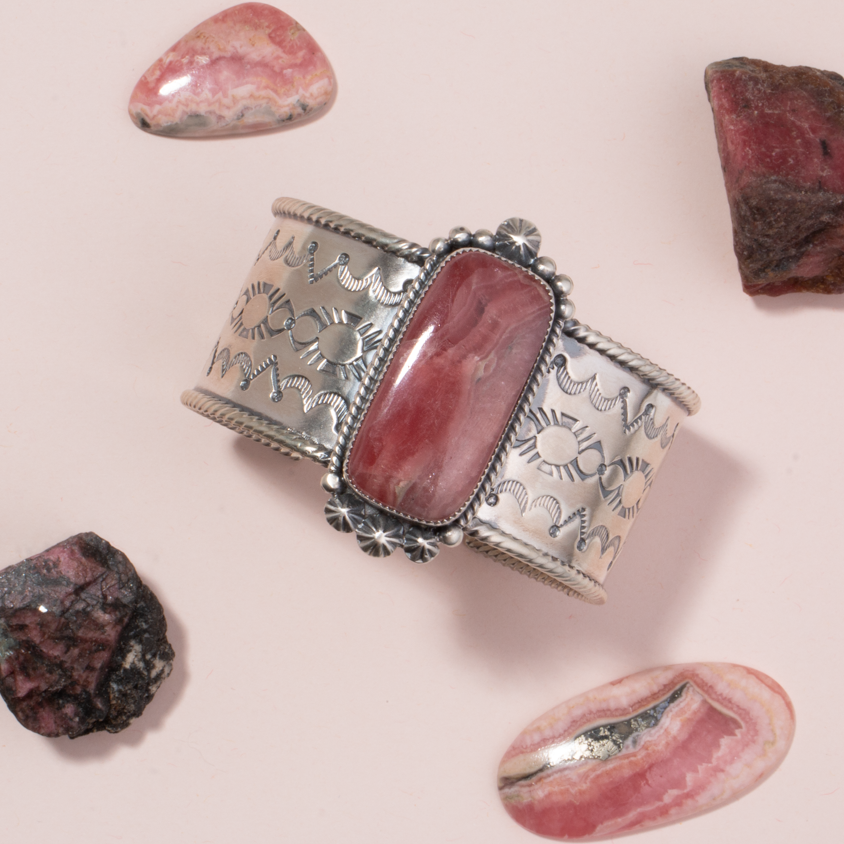
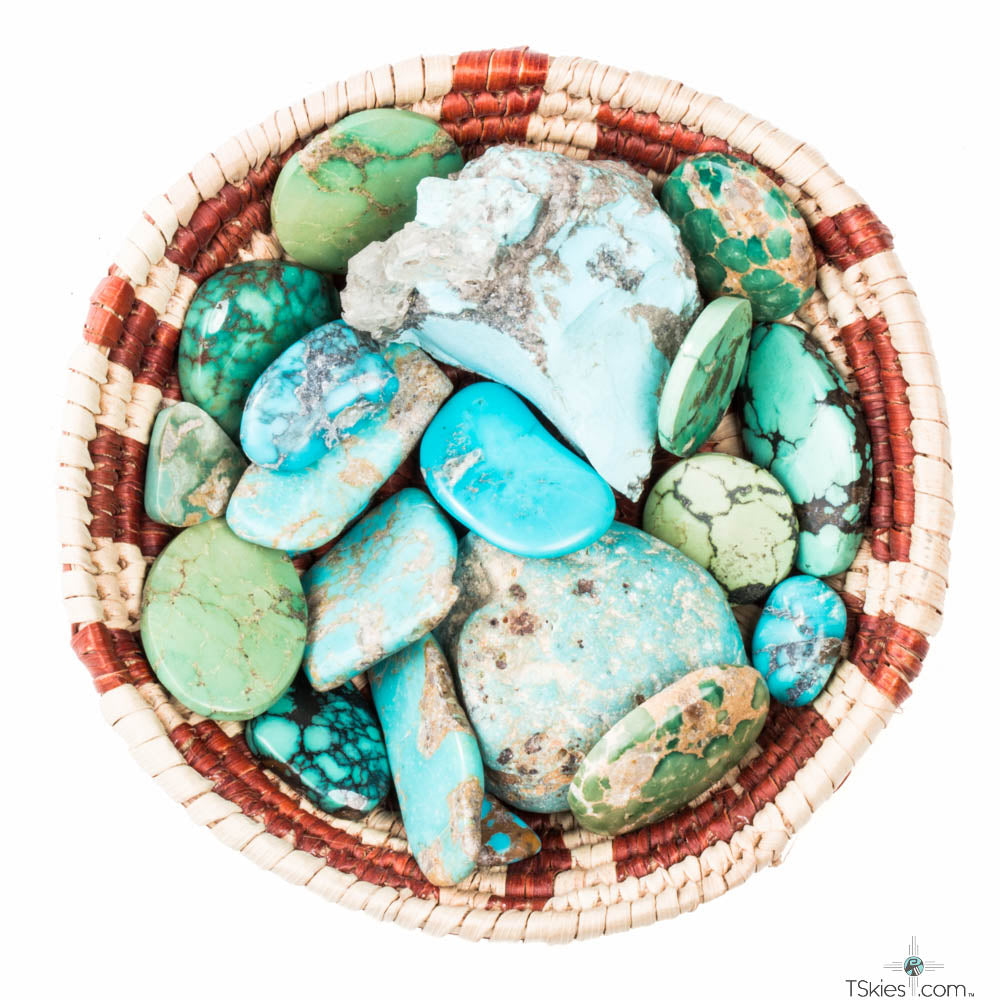
The true beauty of turquoise can be seen in its raw and unused state.
Even the individual elements used by Native artisans face this threat. Turquoise is a natural gemstone, valued by societies all over the world for thousands of years. As the mining of turquoise has decreased the supply of the gemstone over the years, the value of the remaining stones has increased. This value is being threatened by the use of cheaper quality stones in what is billed as high quality, authentic Native American jewelry.

There is also the concern of synthetic materials formed to appear like natural turquoise. Rather than purchasing a beautiful, quality piece of jewelry which will last, buyers are finding they own inferior items which fall apart or become dulled in a short time. This has made some buyers wary of the market, not wishing to spend their money on a product of low quality.


Can you tell the difference between the true, natural turquoise and the more synthetic turquoise?
Competition from these lower quality, mass-produced items also makes it harder for Native artists to stay in the market. Buying authentic supplies and investing the time needed to produce a genuine, handcrafted piece of jewelry requires receiving enough money for their work to continue to produce high quality pieces. Without those prices, many artists are finding it difficult to sell what they make or continue in the industry at all.
There is a way to resolve this problem, and at Turquoise Skies we strive to be part of that solution. Native artists need help marketing their work and getting their voice out into the community. This is an area where Turquoise Skies can help. Our website offers artists the opportunity to connect with buyers, and the chance to tell their story. We want you to see the face of the artist. Through our videos, articles, and photographs, we take you into the homes and workshops of Native artists, giving you the opportunity to listen and become immersed in this beautiful community. To us, allowing the artists themselves to control their own work, their own expressions of their culture, is the best way to preserve those traditions.


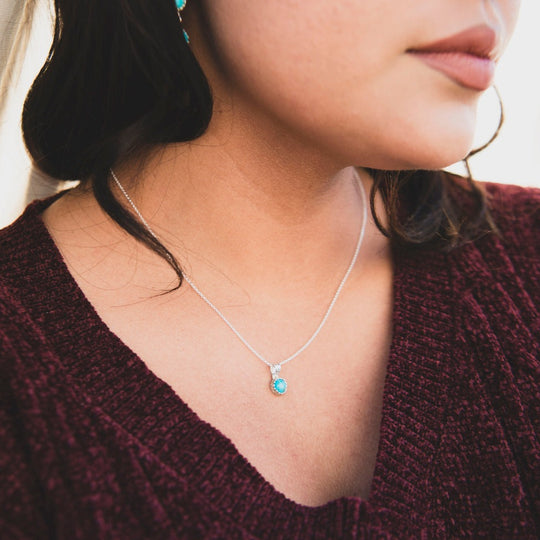
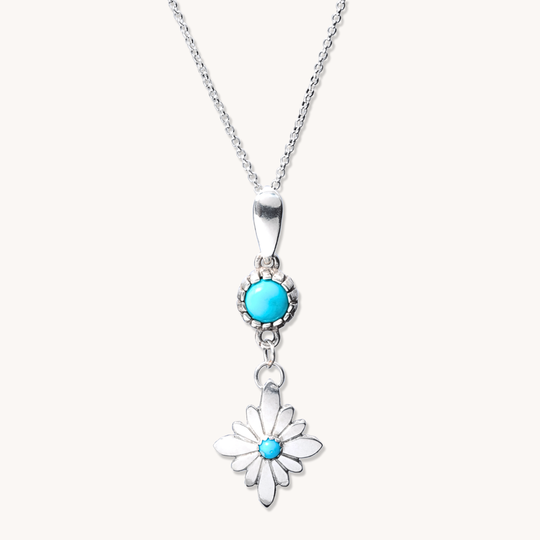
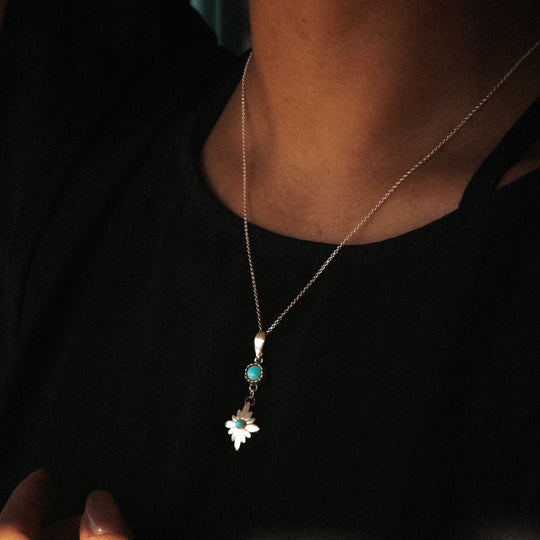
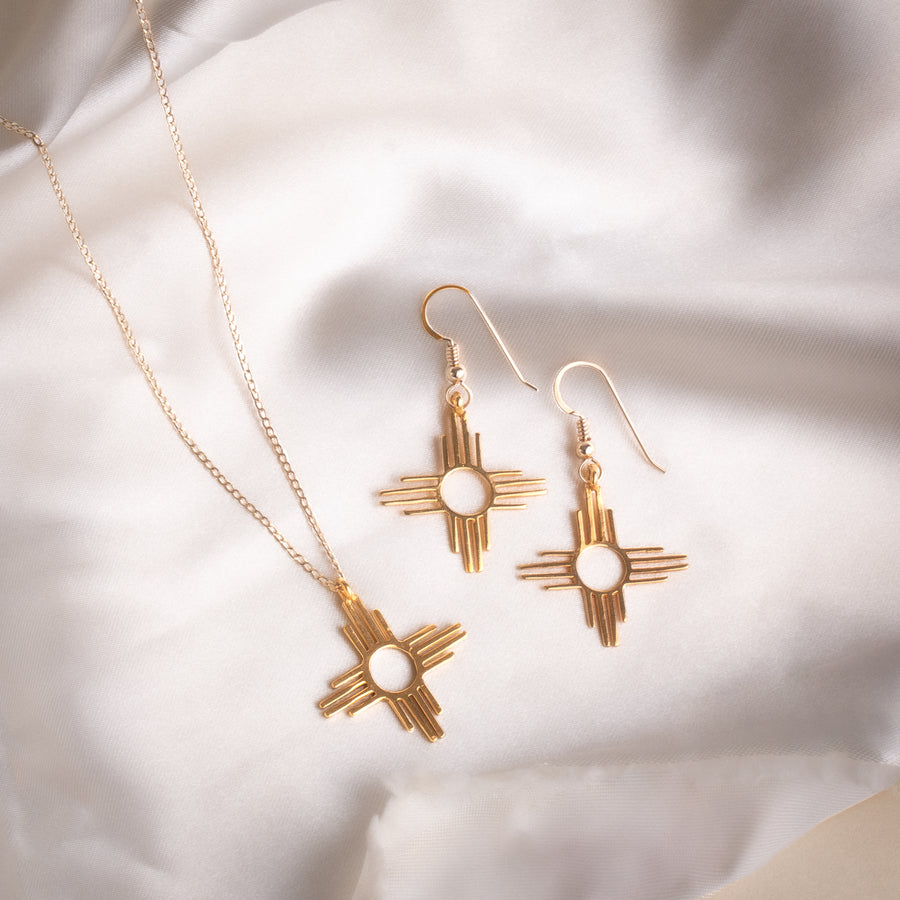
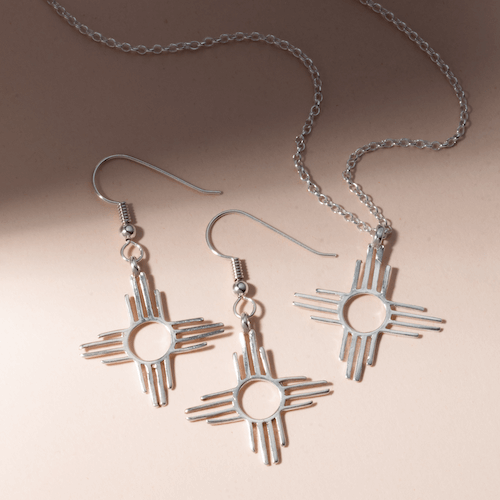
Each one of these necklaces is handmade with the highest quality of materials.
To this end, we at Turquoise Skies commit to offering authentic, handmade Native American art of the highest quality. Every piece will be documented and identified with the artist who created it. We will make the industry as transparent as possible, and support Native artists through offering them a place to tell their stories.
We look to you to help us with this endeavor. Our passion for helping the Native American art and craft industry is real, but we cannot do it alone. Your support is vital. Buy authentic Native American jewelry and art. Help us preserve this creative tradition for the future.
To learn more about our live shows and to purchase authentic Native American jewelry, click here.
What turquoise is made of: from the library
1915 primary source. Anything described as current here describes 1915, not today.
Writing in 1915, the geologist Joseph E. Pogue defined the stone chemically:
“Turquois is a hydrous phosphate of copper and aluminum”
— Pogue (1915), p. 64
According to Pogue (1915, p. 64), any explanation of how turquoise forms has to account for its three ingredients: phosphoric acid, alumina, and copper.
Pogue (1915) was direct about the basic process:
“Turquois is the result of deposition from solution.”
— Pogue (1915), p. 63
He closed his 1915 chapter on its origin this way:
“Turquois, like many minerals, has more than one mode of origin. It is dominantly formed, however, by the percolation of surface waters through aluminous rocks containing apatite and disseminated copper minerals.”
— Pogue (1915), p. 67
From the Library: Lowry, Turquoise: The World Story of a Fascinating Gemstone (2010)
2010 primary source. Anything described as current here describes 2010, not today.
Lowry (2010) places turquoise in a family of related minerals:
“The turquoise group has several minerals in its series. Each of these minerals can be similar to one another in chemical formula, but they are not the same mineral.”
— Lowry (2010), p. 113 [2]
According to Lowry (2010, p. 114), turquoise is the aluminum-rich member of that series, with faustite the zinc-rich member and chalcosiderite the iron-rich member. [2]
Lowry (2010) notes which of them reach the jewelry market:
“Other than turquoise, generally only faustite and chalcosiderite are commonly sold as cabochons in the mineral markets around the world.”
— Lowry (2010), p. 113 [2]
According to Lowry (2010, p. 109), most green turquoise is what mineralogists call ferroan: iron is a strong, abundant coloring agent that tends to dominate when it reaches a forming deposit, which is why green turquoise is common. [2]
From the Library: Kunz, Gems and Precious Stones of North America (1890)
1890 primary source. Anything described as current here describes 1890, not today.
According to Kunz (1890, p. 54), turquoise was a hydrated phosphate of alumina, sometimes containing small quantities of copper, iron or manganese, with a hardness of 6. [3]
According to Kunz (1890, p. 61), several hexagonal crystals of bluish-green turquoise found at Taylor's Ranch on the Chowchilla River, Fresno County, California, were identified by Gideon E. Moore; V. von Zepharovich believed them to be pseudomorphs after apatite crystals, which Kunz thought of great interest for the origin of turquoise. [3]
From the Library: Ryan & Chambless, Turquoise in America Part Two: 1910–1990 (2020)
2020 primary source. Anything described as current here describes 2020, not today.
Richard M. Shull, in an appendix to Ryan & Chambless (2020, p. 338), described turquoise as a hydrated copper aluminum phosphate that is almost never found pure. It belongs to the turquoise group of phosphates that share four water molecules: faustite has zinc in place of some of the copper and can be lime green, and chalcosiderite has copper but lacks turquoise's aluminum. Testing often comes down to deciding which mineral a sample is most like. [4]
According to Richard M. Shull, in an appendix to Ryan & Chambless (2020, p. 338), copper gives turquoise its blue and more iron makes it greener. Metal oxides such as iron oxide and manganese create matrix patterns, including the prized spiderweb, and silica present during formation makes the stone denser and harder, with a higher luster. [4] Stacey (1975, p. 28) also describes pure blue turquoise as a copper aluminum phosphate, and notes that in deposits where iron takes the place of part of the copper, green dominates the stone. [7] Jacka (1995, p. 78) also writes: "The bluer colors of turquoise come from association with copper; the greener colors from iron." [8]
Richard M. Shull, in an appendix to Ryan & Chambless (2020, p. 338), explained that jewelry turquoise is cryptocrystalline, meaning its crystals are too small to see, so it looks smooth and uniform. Individual crystals visible to the eye form only rarely and are prized as mineral specimens. [4]
Richard M. Shull, in an appendix to Ryan & Chambless (2020, p. 339), called turquoise idiochromatic: the copper in its own formula sets its colour, although iron and other impurities shift it. Variscite, by contrast, is white when pure and takes its colour from impurities such as vanadium, chromium and iron. [4]
According to the mine glossary in Ryan & Chambless (2020, p. 342), the Bishop Mine at Lynch Station, Campbell County, Virginia is the only known source of turquoise crystals in the United States. [4]
From the Library: Khazeni, Sky Blue Stone (2014)
2014 primary source. Anything described as current here describes 2014, not today.
Khazeni (2014) described how turquoise begins:
“A hydrous phosphate of copper and aluminum, it is born in igneous rocks, as magma, fiery liquid deep within the earth, surges toward the surface, pools, and solidifies.”
— Khazeni (2014), p. 17 [5]
Khazeni (2014) quotes a nineteenth-century Persian natural history on how slowly it forms:
“It is said turquoise is like a cherry—the more it ripens, the better. But all the cherry needs to ripen is the sun of one season, whereas for turquoise it takes one thousand years”
— Khazeni (2014), p. 17 [5]
On colour, Khazeni (2014) wrote:
“While turquoise can have many shades, including a common pale green caused by traces of iron, the finest stones, deemed gems—those aged for thousands of years in the oldest rocks—are sky blue.”
— Khazeni (2014), p. 18 [5]
According to Khazeni (2014, p. 18), because turquoise lay only a few hundred feet below ground and was easily extracted, miners went into caves with shovels, pickaxes and hammers, and windlasses raised the stone, still in its matrix, from the mines. [5]
Khazeni (2014) on where the name came from:
“The stones that arrived in the markets of Europe came overland from Iran through the Ottoman Empire—and were thus known as “Turkish,” turchese in Italian and turquoise in French.”
— Khazeni (2014), p. 71 [5]
Khazeni (2014, pp. 85–86) found the same explanation in the English lapidary of Thomas Nichols (1652): “While the Persian name given for the stone was firuza, in Europe it was called turquoise, because it was ‘brought from the Turks.’” [5]
According to Khazeni (2014, p. 88), nineteenth-century mineralogists measured turquoise at about 6 on the Mohs scale, soft compared with other gems, with a specific gravity between 2.60 and 2.88, and traced its blue to an oxide of copper. [5]
From the Library: Lowry, Turquoise Unearthed: An Illustrated Guide (2002)
2002 primary source. Anything described as current here describes 2002, not today.
Lowry (2002) on what makes it blue or green:
“Generally speaking, stones with more copper content appear bluer, while those with less copper and more iron are greener.”
— Lowry (2002), p. 3 [6]
As of 2002, Lowry (2002, p. 20) noted that New Mexico and Arizona both recognized turquoise as their state gem, and Nevada had designated it the semiprecious state gem. [6]
Lowry (2002) on fossil turquoise:
“Turquoise fossils occur when turquoise minerals migrate to and replace the original calcium-rich skeletal material of primordial, long-buried plants or animals.”
— Lowry (2002), p. 42 [6]
According to Lowry (2002, p. 43), a fossil upper jaw of a yellow-bellied marmot from caves in the Potosi Mountains, southwest of Las Vegas, has teeth whose enamel turned to pure turquoise after thousands of years in copper-rich groundwater. [6]
From the Library: Stacey, Turquoise Blue Book and Indian Jewelry Digest (1975)
1975 primary source. Anything described as current here describes 1975, not today.
Joseph Stacey, editor of Arizona Highways, gave a different origin in Stacey (1975, p. 26): he wrote that French speakers coined the name for a stone that came from Turkestan, the vast region of Central Asia between the Caspian Sea and the Gobi Desert, and that the Middle English form was Turkeis. [7]
Field Notes by Mateo James
I notice Kunz (1890) defined turquoise as a phosphate of alumina that only sometimes contains small amounts of copper, while Pogue (1915) named copper as one of its main ingredients.
I notice Pogue (1915) wrote that turquoise is seldom found below 100 feet, while Khazeni (2014) describes it as lying only a few hundred feet below ground. Both agree it is a shallow mineral, but not on how shallow.
I notice Khazeni (2014) gives the trade-route explanation of the name: Persian stones reached Europe overland through the Ottoman Empire and so were called Turkish. Pogue (1915) knew that explanation but thought it more probable that the Nishapur mines were once counted as part of a loosely defined 'Turkey'.
I notice a third answer to where the name comes from. Joseph Stacey, in the 1975 Turquoise Blue Book, traced it to stones from Turkestan in Central Asia, where Khazeni (2014) points to Persian stones reaching Europe through Ottoman trade and Pogue (1915) to Nishapur being counted as part of a loosely defined 'Turkey'. I have set Stacey's version beside the others rather than choose among them.
Browse our turquoise jewelry →
Sources
- Pogue, Joseph E. The Turquois: A Study of Its History, Mineralogy, Geology, Ethnology, Archaeology, Mythology, Folklore, and Technology. Memoirs of the National Academy of Sciences, Vol. XII, Part II, Third Memoir. Washington, 1915. Public domain. Cited by printed page. Statements describe conditions as of 1915.
- Lowry, Joe Dan, and Joe P. Lowry. Turquoise: The World Story of a Fascinating Gemstone. Layton, UT: Gibbs Smith, 2010. Cited by printed page. Statements describe conditions as of 2010.
- Kunz, George F. Gems and Precious Stones of North America. New York: The Scientific Publishing Company, 1890. Public domain. Cited by printed page. Statements describe conditions as of 1890.
- Ryan, Mike, II, and Philip Chambless. Turquoise in America, Part Two: 1910–1990. Callais Press, 2020. Cited by printed page. Statements describe conditions as of 2020.
- Khazeni, Arash. Sky Blue Stone: The Turquoise Trade in World History. The California World History Library 20. Berkeley: University of California Press, 2014. Cited by printed page. Statements describe conditions as of 2014.
- Lowry, Joe Dan, and Joe P. Lowry. Turquoise Unearthed: An Illustrated Guide. Photography by Mark Nohl. Tucson, AZ: Rio Nuevo Publishers, 2002. Cited by printed page. Statements describe conditions as of 2002.
- Stacey, Joseph, ed. Turquoise Blue Book and Indian Jewelry Digest. Arizona Highways Collectors Series. Phoenix: Arizona Highways (Arizona Department of Transportation), 1975. Cited by printed page. Statements describe conditions as of 1975.
- Jacka, Lois Essary. Navajo Jewelry: A Legacy of Silver and Stone. Photographs by Jerry Jacka. Flagstaff: Northland Publishing, 1995. Cited by printed page. Statements describe conditions as of 1995.