


The Price of Patina
Did you know that the tarnish on your old vintage Native American jewelry is actually very valuable? Metal jewelry develops a sheen called patina as it ages. Patina is caused by the oxidation of the metal when exposed to the air. So before you go cleaning your vintage jewelry, know that this darkened discoloration is worth big bucks.
In the image above, (left) is a new silver bead that has been oxidized with the chemical treatment using liver of sulfur, then polished in the center. (Right) A handmade bench bead from the 1970s that is naturally oxidizing and any polishing is due to rubbing and natural wear.
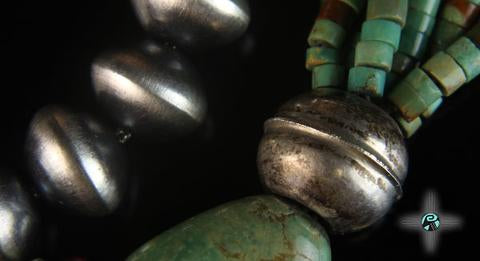
Natural patina is a sign of the history of the individual piece, having grown more beautiful and increased in worth with the passing of time. Natural patina forms slowly over a long period of time as parts of the jewelry are exposed to water in the atmosphere. Also, as a piece is naturally worn, parts of the metal come into contact with the skin and other surfaces. As the surfaces rub together the metal is naturally polished and stripped of the tarnished layer. This leaves a naturally aged piece darkened in the deep untouched areas and slightly polished in the parts that come into contact with rubbing. This is an aesthetically appealing look and most people who invest in vintage jewelry want to keep that mixed patina. Historians and jewelry appraisers also use this as one indicator when determining the age of a piece.

Natural patina formed on this bracelet over time. You can see that some of the silver beads and the inside of the band are shiny and have a slight polish from skin contacts and natural wear.
Often this patina look is so sought after that artists who want to make their jewelry have a vintage looking appearance replicate it. The darkened sheen can be reflected through intentional techniques such as chemical oxidization. Though it is almost impossible to exactly replicate the natural oxidation and wear polishing that is produced over time, a good artist can get pretty close.

poorly done chemical oxidation. you can see some of the splotchy inconsistencies
When should you clean your vintage Native American jewelry?
Most of the time when people ask this question they are not aware of the value associated with the patina. Knowing that the darkened tarnished look is valuable may change your mind about polishing it, however consider another factor. What do you like? If you own a piece of jewelry, then it is yours to wear however you like it. If you do not like the patina look then don’t force yourself to keep it that way. It is your piece and you can do what you want with it. Silver and gold can easily be brought back to their glossy shine with proper cleaning and polishing techniques. Just remember, if you ever want to have your piece sold or appraised, removing the patina greatly reduces its value.
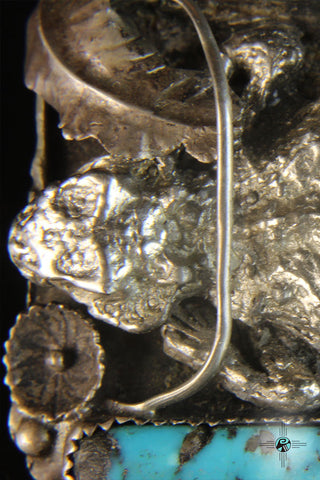
1960s horned toad, natural patina development around the pieces such as in the silver flower. The toad still looks polished as it has been rubbed by its owner for good luck.
For cleaning and everyday care, see our guide: How to Care for and Clean Native American Jewelry.
From the Library: Welch, Indian Jewelry (1973)
1973 primary source. Anything described as current here describes 1973, not today.
Writing in 1973, Welch gave buyers a rule of thumb about shine and age:
“Generally speaking, if the jewelry is bright and shiny it probably is not very old. It may, however, be of good quality.”
— Welch (1973), p. 52 [1]
Welch (1973) added a warning:
“But beware! Just because it's dull does not mean it's old.”
— Welch (1973), p. 52 [1]
Welch (1973, p. 57) wrote that wearing a piece was the best treatment for it, because air, sunlight, heat and cold help develop the patina collectors prize. [1]
From the Library: Lund, Indian Jewelry: Fact and Fantasy (1976)
1976 primary source. Anything described as current here describes 1976, not today.
Lund (1976) on telling chemical blackening from natural age:
“Chemical tarnishing produces a blacker color than the natural ageing process, which is more of a charcoal gray, and in pieces which have aged naturally, there is often a very fine layer of lint deposit present, adhering to the oils which have collected.”
— Lund (1976), p. 119 [2]
Lund (1976, p. 119) cautioned that tarnish, or its absence, was not by itself a sign of age, since artificial aging with chemicals had become common; a chemically aged piece often showed blackening that started and stopped for no logical reason where the maker had rubbed it off. [2]
From the Library: Baxter, Encyclopedia of Native American Jewelry (2000)
2000 primary source. Anything described as current here describes 2000, not today.
Baxter (2000) explained why patina matters to collectors:
“Patina is thus a natural polish that experts scrutinize to determine the age and authenticity of a jewelry piece.”
— Baxter (2000), p. 130 [3]
She added, in 2000:
“Devotees of older native-made jewelry particularly value the patina of pieces made from ingot and coin silver, which can have a dull, darker tone, but which can often also possess an almost satiny finish.”
— Baxter (2000), p. 130 [3]
From the Library: June, Fred Harvey Jewelry 1900–1955 (2013)
2013 primary source. Anything described as current here describes 2013, not today.
Writing in 2013, June (2013) described how the earliest silversmiths finished their work:
“Polished finishes were applied by rubbing, first with sandy clays, then ashes, and finally with leather. Mirror polishes were unknown.”
— June (2013), p. 24 [4]
Writing in 2013 about delicate split-shank cuffs, June noted the cost of a repair:
“when repairs require soldering (as most do), the combination of heat and acid washing removes any accumulated patina.”
— June (2013), p. 114 [4]
June (2013) described what natural patina is made of:
“In all forms of silver jewelry, body oils mix with the oxidized copper and redeposit the mixture on the silver, seeping into the surface, creating a rich, deep glow.”
— June (2013), p. 134 [4]
June (2013) added a warning for anyone sending an old piece out for repair:
“Also, the steps required in soldering (such as with repairs) destroy patina altogether.”
— June (2013), p. 134 [4]
June (2013) gave a time scale for tarnish:
“It takes about fifteen or twenty years for brightly shined silver to blacken.”
— June (2013), p. 135 [4]
According to June (2013, p. 136), patina takes years to build and a long time to restore once it has been stripped by chemicals or repair heat; if it has not been stripped, the tarnish left in the silver lets it grow back in months rather than years. [4]
Sources
- Welch, Frankie. Indian Jewelry: How To Wear, Buy and Treasure America's First Fashion Pieces. McLean, VA: EPM Publications, Inc., 1973. Cited by printed page. Statements describe conditions as of 1973.
- Lund, Marsha Mayer. Indian Jewelry: Fact and Fantasy. Boulder, CO: Paladin Press, 1976. Cited by printed page. Statements describe conditions as of 1976.
- Baxter, Paula A., with Allison Bird-Romero. Encyclopedia of Native American Jewelry: A Guide to History, People, and Terms. Phoenix: Oryx Press, 2000. Cited by printed page. Statements describe conditions as of 2000.
- June, Dennis. Fred Harvey Jewelry 1900–1955. Atglen, PA: Schiffer Publishing, 2013. Cited by printed page. Statements describe conditions as of 2013.