







Native American Inlay Jewelry
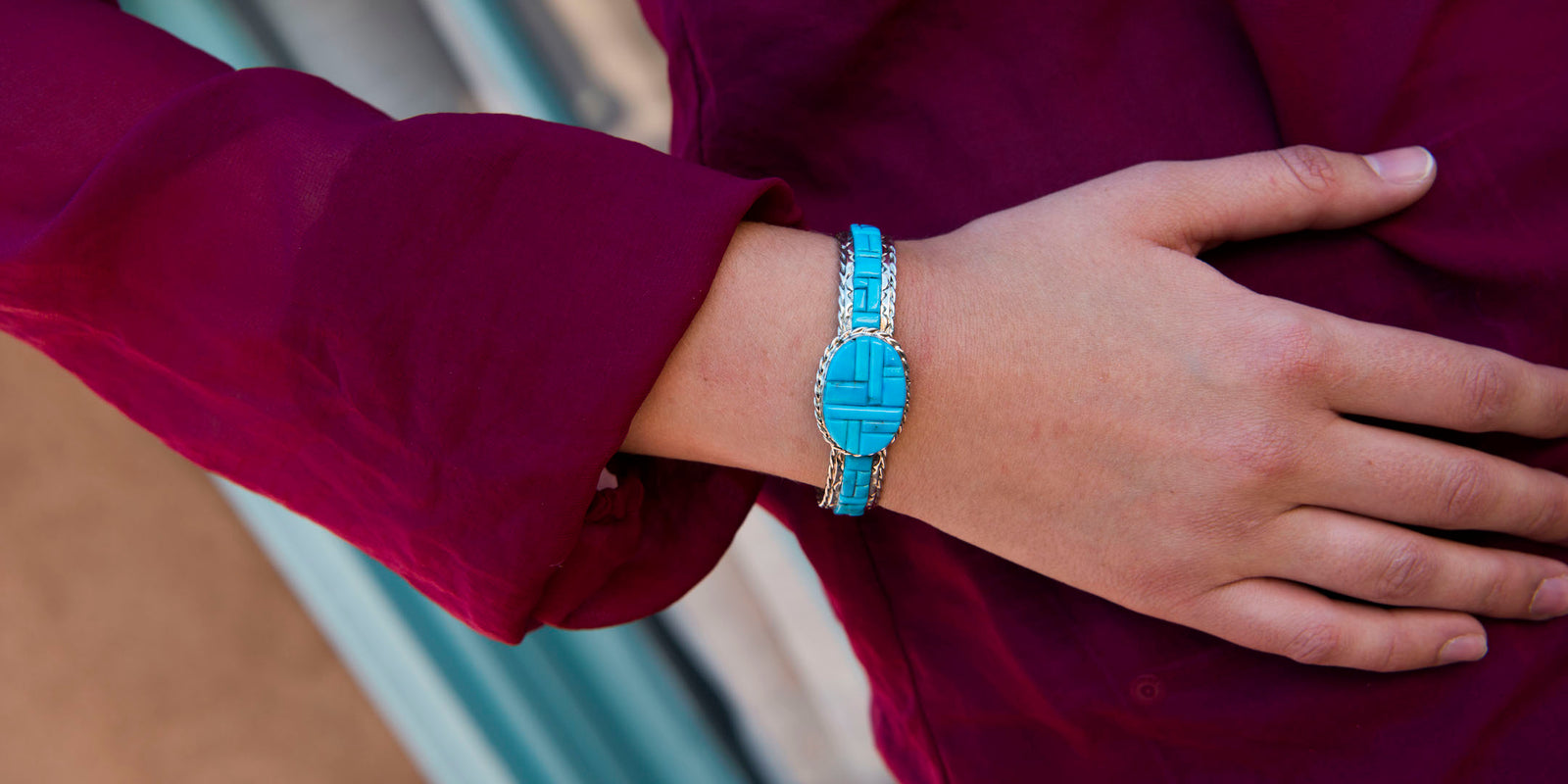
Native American inlay jewelry is one of the most sought after styles. The popularity of Native American jewelry has allowed tribal artists to explore and expand the boundaries and concepts of their art. Infusing their work with a blend of their own traditions and culture and art concepts from around the world has opened the doors of their creativity in a way that makes the market for their jewelry an exciting one. Whether you’re looking for vintage jewelry or modern adaptations of ancient traditions, today’s world of Native American jewelry has what you seek.

Native American jewelry comes in a wide variety of styles. One of the most popular is what is known as inlay jewelry. This style was first mastered by the Zuni and has become a favorite type of jewelry in the modern market. For the artist, inlay provides freedom to craft their own designs using traditional symbols and motifs. Inlay also requires a great deal of skill on the part of its creator, which is what makes the finished piece a true work of art.
Inlay jewelry uses stones which are cut and shaped to fit the form of the artist’s design. The stones create a mosaic that reveals the artist’s attention to detail. Intricate patterns and varied sizes and colors of the pieces add to the resulting beauty of the item. Some artists use silver interlaced with the stones to create geometric designs in their pieces. Once finished, the stones are sanded to be even with the metal. Epoxy is used to create a smooth surface.
For the full history of inlay, with every claim cited to our reference library, see Inlay: Stone Set Into Silver.
Types of Native American Inlay Jewelry
There are different styles of inlay jewelry, each depending on the manner in which the stones in the piece are held in place:
- Channel Inlay
- Stone to Stone Inlay
- Mosaic Inlay
- Chip Inlay
To create a piece of channel inlay jewelry, the artist creates a series of channels in the metal which will hold the stones in place. Stones are carefully measured and cut before being placed in the channels according to the design. The finished piece will be a fusion of the stones and the metal. Channel inlay is considered a more traditional approach to inlay jewelry. It allows for a wide variety of color combinations and complex patterns.

Stone to stone inlay requires a great deal of skill and is considered a more modern take on the traditional type of jewelry. Pieces are shaped and placed next to surrounding stones without the channels, creating a unique design that still relies on metal housing as a base. The design uses sidewalls to surround the stone clusters. A strong epoxy is used to secure the stones.

Mosaic inlay is basically a type of stone to stone inlay as the same methods are used. With mosaic inlay however there is usually one silver housing to secure the piece rather the stones hold themselves in a particular shape. Artists use this method to create beautiful stone fetishes and abstract tribal designs.

Chip inlay is a technique of combining crushed stone with epoxy resin and placing the mixture into a cavity in the metal. The artist credited with first using this technique in his work was Tommy Singer, who began using it in 1970.

Whether traditional in design or more modern in tone, whether channel, stone to stone or chip, inlay jewelry remains one of the most popular styles of Native American jewelry in today’s market. With its creative designs and blend of expressions, it is likely to remain a popular choice with Native American artists as well.
Resources:
http://shumakolowa.com/pages/jewelry-collectors-guide
https://nativeamericanjewelrytips.wordpress.com/category/design-style/chip-inlay/
https://tskies.com/12-native-american-jewelry-styles/
https://www.palmstrading.com/zuni-jewelry/
https://www.palmstrading.com/how-do-you-know-its-authentic-jewelry/
http://www.durangosilver.com/inlay_turquoise_jewelry.asp#sthash.ErCTR89N.dpuf
http://www.durangosilver.com/inlay_turquoise_jewelry.asp
From the Library: Tryk, Santa Fe Indian Market (1993)
1993 primary source. Anything described as current here describes 1993, not today.
Tryk, writing in 1993, on how prehistoric Southwestern artists set their mosaics:
“They backed their mosaics with lac, a resinous material secreted by the lac insect, or glued them down with pine gum.”
— Tryk (1993), p. 52 [1]
Tryk (1993) on a modern pioneer:
“Dennis Edaakie, a Zuni, pioneered finely detailed realistic animal, bird and flower inlays on silver jewelry.”
— Tryk (1993), p. 79 [1]
From the Library: Tanner, Navajo Silver Craft (1954)
1954 primary source. Anything described as current here describes 1954, not today.
Writing in 1954, Tanner described channel work, then one of the newest techniques:
“In channel work, the turquoises are set into the silver in such manner that the metal and stones are flush in the finished piece.”
— Tanner (1954), p. 32 [2]
According to Tanner (1954, p. 32), the turquoise was cut in many shapes, including squares, triangles and oblongs, and set with narrow bars of silver between the stones. She saw the technique used on bracelets, earrings, rings and salad sets. [2]
On who made channel pieces in 1954, Tanner (1954) reported:
“Generally, the Navajo does all the silver work, and Zuñi smiths cut and set the stones.”
— Tanner (1954), p. 32 [2]
Tanner (1954, p. 32) noted that the old combination of turquoise, shell and a black stone was still being set with silver in 1954. In pre-Columbian times the three materials were laid in a gummy substance on a wood or shell base. In the silver pieces, she wrote, the Navajo often did the silverwork and the Zuñi added the inlay. [2]
According to Tanner (1954, p. 25), silver was worked alone for some years, without any decorative stone, before smiths paired it with turquoise. Other materials followed, and by 1954 a single elaborate Zuñi piece might include a mosaic of turquoise, shell, coral and a black stone. [2]
Sources
- Tryk, Sheila. Santa Fe Indian Market: Showcase of Native American Art. Photography by Mark Nohl; introduction by Allan Houser. Santa Fe, NM: Tierra Publications, in cooperation with SWAIA (Southwestern Association on Indian Affairs), 1993. Cited by printed page. Statements describe conditions as of 1993.
- Tanner, Clara Lee. “Navajo Silver Craft.” Arizona Highways 30, no. 8 (August 1954): 16–33. Cited by printed page. Statements describe conditions as of 1954.


