


History of Native American Cluster Jewelry
Native American jewelry has a long history of creativity and unique design. This history is part of what has kept its appeal over the years. Native American artists blend their traditional culture with their individual artistic vision to create the one of a kind pieces desired by those who purchase them. The wide variety of styles used to create these pieces adds to the bounty purchasers have to choose from. One such style is called a “cluster”.

The term “cluster” refers to the stones in the piece being arranged in a close pattern. Stones which share a similar size and shape are used to create the design of these pieces. The pattern of the design may be an organized or an unorganized one, as determined by the choice of the artist.
According to one source, the cluster style was developed by Zuni artists in the 1920s and 1930s when they began to cluster groups of hand-cut gemstones in intricate designs. The designs they created resembled items such as snowflakes and flowers. Traditionally, Zuni artists used turquoise, coral and jet, although today’s artists use a wide variety of gemstones. The type of cluster is determined by both the size and the shape of the stones used. Zuni artists have designated two types of clusters: petit point and needlepoint. Needlepoint clusters have stones cut thin to resemble a needle. Petit point contains stones in square, rectangular, round or oval shapes.

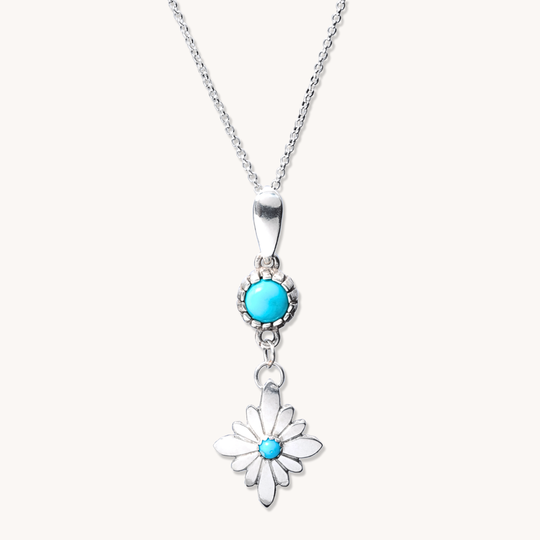
There are also two more general types of cluster jewelry: arranged and random. With an arranged cluster, the pattern consists of a center stone, which is usually the largest stone in the piece, surrounded by smaller stones placed in an even design. One of the most popular patterns used for arranged clusters is the sunburst.
A random cluster has less organization to the pattern of the stones, although they are still placed evenly on the piece. The stones are also not as similar. Due to the need for careful measurement and placement, however, even a random cluster is an intricate piece. At every step of the creation of this jewelry, the artist must use great skill and patience. The process of hand-cutting the stones takes time and care and arranging them in an attractive pattern requires artistic vision. When you purchase a cluster style piece of jewelry, you have truly gained a unique, handcrafted piece which will be a pleasure for a lifetime.

Resources:
https://tskies.com/blogs/news/12-styles-of-native-american-jewelry
http://shumakolowa.com/pages/jewelry-collectors-guide
From the Library: Adair, The Navajo and Pueblo Silversmiths (1944)
1944 primary source. Anything described as current here describes 1944, not today.
According to Adair (1944, p. 39), by the late 1930s Navajo smiths who could not afford large stones bought small rough pieces, a by-product of mining, polished them themselves, and set them in single and double rows along a bracelet and in clusters around larger stones, a use of turquoise Adair said came from Zuñi. [1]
Adair (1944) described the first Zuni set work of the 1890s:
“It resembles the type of jewelry the Navajo have always prized-heavy in construction with a few wellmatched pieces of massive stone.”
— Adair (1944), p. 131 [1]
According to Adair (1944, p. 134), by 1910 Zuni bow-guards were encrusted with stones and conchas carried a center stone and often a rim of stones around the edge. [1]
Field Notes by Mateo James
This article dates the Zuni cluster style to the 1920s and 1930s. Adair, writing in 1944, describes Zuni conchas ringed with stones and bow-guards encrusted with them by 1910, a decade or more earlier. The two dates differ, so I show both.
Sources
- Adair, John. The Navajo and Pueblo Silversmiths. The Civilization of the American Indian Series. Norman: University of Oklahoma Press, 1944. Cited by printed page. Statements describe conditions as of 1944.