



Turquoise Mines: A Documented Turquoise Stone Study — Real Stones by Mine
Every turquoise mine has a fingerprint — a signature range of color and matrix. We're documenting it, mine by mine, with real stones from a private collection photographed in the T.Skies studio.
Turquoise by mine
Browse the famous turquoise mines below. Mines tagged “stone study” have a gallery of real, documented stones — part of our Documented Turquoise Stone Study. Detailed notes by state follow.
 Carico Lake● Stone study live
 Pilot Mountain● Stone study live
 Sleeping Beauty● Stone study live
 Egyptian (Sinai)● Stone study live
Carico Lake, Nevada
Famous for an unusually wide range — classic blue with black spiderweb, the mine's signature apple-green, and the apple-green faustite it is known for. Eight documented stones, photographed close.
See the Carico Lake stone study →The turquoise in Southwestern jewelry comes from named mines scattered across the American West, and the mine a stone came from shapes its color, its matrix and its story. These are our field guides to 18 of them — grouped by state, each linking to a full guide on what that mine produced and how to recognize it. Further down: how turquoise forms, how it is mined, and sourced profiles of 27 American mines and six countries.
How turquoise forms
Turquoise is a copper aluminum phosphate that forms near the surface, mostly in dry country, where water seeping down through weathered rock leaves copper, aluminum and phosphorus behind in cracks and pockets.
Philip Chambless and Mike Ryan (2021) call it “a hydrous basic copper aluminum phosphate.” Joseph Pogue (1915) traced the phosphorus to apatite, the aluminum to feldspar and the copper to “disseminated copper ores,” and concluded that turquoise is formed mainly “by the percolation of surface waters through aluminous rocks containing apatite and disseminated copper minerals.” Joe Dan and Joe P. Lowry (2010) call it “a secondary formation,” filling veins and nuggets in “the shape and size of the existing fractures and cavities.” Deposits “generally form in arid climates,” they write.
The books give different depths. Chambless and Ryan place turquoise “close to the surface within a zone of 10 to 60 feet”; the Lowrys, “generally no deeper than 30 to 100 feet”; Pogue, “seldom below 100 feet.” Host rock caught up in the stone becomes its matrix, which Chambless and Ryan call “an essential part of turquoise.” Pogue credited copper with the color and iron with “a modifying influence upon its shade”; the Lowrys call iron “a strong and abundant chromophore” in green turquoise. None of these books says how long turquoise takes to form.Sources: Chambless & Ryan (2021), pp. 80, 174–75; Pogue (1915), pp. 23, 64, 66–67; Lowry & Lowry (2010), pp. 104–05, 109.
How turquoise is mined, then and now
Turquoise is mined mostly by hand. Miners follow shallow veins and pockets with picks, hammers and chisels, use blasting or heavy equipment to move the rock around them, and much American turquoise has come up as a by-product of copper mining.
Native Americans “had been mining turquoise for over a thousand years when settlers first identified it in 1857,” write Chambless and Ryan (2021). Pogue (1915) recorded “Many stone hammers” in the ancient workings at Cerrillos, and the Lowrys (2010) describe “Stone mauls, hammers, and antlers” used to drive wedges into the rock. Fire-setting is disputed. Kunz (1890) described fires built against the rock and doused with water at Cerrillos, noting that “much of the turquoise is ruined in the process”; the Lowrys doubt it was ever much used, since the stone “would probably fracture, discolor, and burn.”
During the Great American Turquoise Rush of 1890–1910, “mining it was labor intensive,” with material “carefully mined and sorted by hand” (Chambless and Ryan). Because turquoise lies close to the surface, blasting “must be done in a gentler manner to preserve the turquoise.” After 1910, they write, turquoise was mined “by small-scale ventures” or came as “a by-product of mining for other minerals.” By the early 1950s open-pit copper mines were exposing it in their waste rock, and the mining companies took up the practice of “leasing out the turquoise concession to remove turquoise from the waste dumps.” Heavy equipment now moves much of the rock, but in the Lowrys’ words, “Each time a seam of color is uncovered, it is removed with hand tools.”Sources: Chambless & Ryan (2021), pp. 17, 19, 174, 186; Pogue (1915), p. 52; Kunz (1890), pp. 56–57; Lowry & Lowry (2010), pp. 122–23, 130–31.
Nevada
Arizona
New Mexico
Colorado
Turquoise mines, profiled
Short profiles of 27 American mines and six countries, grouped by state and country. Each one draws on at least two books where our shelf allows, and says so where it doesn’t. Where a mine has its own field guide, the link is at the end of its profile.
Nevada turquoise mines
Blue Diamond Nevada · Lander County
Blue Diamond lies “northeast of Iowa Canyon in Lander County, Nevada” (Lowry, 2010); Branson (c. 1975) places it “south of Austin.” Lowry dates “the largest production of these deposits” to “the early 1970s,” when a bulldozer uncovered “small and large plate formations of turquoise.” Host rocks varied, “with the most common being a black chert, which created a swirl of matrix.” The two books describe the color differently. Lowry gives “between a washed-out mixture of blue and green and a nice dark blue”; Branson gives “a very hard light to deep blue turquoise” with “brown to black matrix,” and adds that the mine “cannot be mined in the winter months.” Neither gives a current status.Sources: Lowry & Lowry (2010), pp. 225–26; Branson (c. 1975), p. 42; Schiffer (2008).
Blue Gem Nevada · Lander County
Lowry (2010) places Blue Gem “about six miles south of the town of Battle Mountain,” at an open-pit copper and gold mine in the Bullion District. He describes a prehistoric site rediscovered in 1934 that has produced turquoise “as deep as 800 feet”; Branson (c. 1975) says production “started about 1934, has continued intermittently.” Branson singles out “the intense blue to the deep green combinations of colors in a single stone,” and Schiffer (2008) gives “deep blue to deep green coloring in the same stone.” Branson also cautions that “similar stones from other mines are often sold as ‘Blue Gem’ turquoise” and that “In Nevada there are several Blue Gem Mines.” The books differ on status by date: “still producing turquoise” (Branson, c. 1975); production “continued until the early 1980s” (Lowry, 2010).Sources: Lowry & Lowry (2010), pp. 223–24; Branson (c. 1975), pp. 16–17; Schiffer (2008). Blue Gem field guide →
Candelaria (Columbus District) Nevada · Esmeralda & Mineral counties
Chambless & Ryan (2021) write that J.L. Clayton “is generally credited with the discovery of turquoise in Nevada sometime in the mid-1870s, about five miles from the town of Columbus in the Candelaria Hills.” Pogue (1915) names him J. E. Clayton and says the date “can not now be ascertained, but it was probably during the seventies.” Kunz (1890) relays a report of turquoise “in seams and bunches in a metamorphic sandstone of a brownish color,” cut together with its host rock into “a rich mottled stone for jewelry.” Pogue describes two later prospects nearby, one “in a dark-gray, cherty rhyolite,” where “Very little work has been done.” Lowry (2010) treats Candelaria as a district “along the county lines of Esmeralda and Mineral counties”: “Whenever the area is actively mined for its metals, more turquoise and variscite becomes available.”Sources: Chambless & Ryan (2021), p. 157; Pogue (1915), p. 50; Kunz (1890), pp. 60–61; Lowry & Lowry (2010), p. 233.
Carico Lake Nevada · Lander County
Lowry (2010) reports “Prehistoric mining evidence of stone tools” in the Carico Lake Valley and writes that “the first recorded mining activity was in 1909.” Branson (c. 1975) gives the mine as “Formerly known as Stone Cabin Mine,” a name Lowry and Schiffer (2008) also record, and describes “an open-pit operation” where “Mining is done with large machinery.” In Branson’s words, its colors “run from light green to deep blue, all about the same hardness,” and the stone comes as nuggets, veins, large nodules and some “nuggets with a rough, knobby surface” sold as “seafoam.” Lowry adds that the area “has produced many colors of turquoise as well as the apple green mineral faustite.” Seafoam alone does not identify the mine: “Many mines have produced this type of nugget” (Branson). Neither book gives a current status.Sources: Lowry & Lowry (2010), pp. 233–34; Branson (c. 1975), pp. 25, 44; Schiffer (2008). Carico Lake field guide and stone study →
Crescent Peak Nevada · Clark County
Chambless & Ryan (2021) place the Crescent Peak Mine, “also known as the Simmons Mine,” in Clark County, in a district that “lies about seventeen miles west of Searchlight.” In 1896 George Simmons, prospecting in the district, found a piece of stained quartz and “searched for eight months before locating a mine that had been worked long ago.” A patent issued in 1908 covered eleven claims, “the largest group of turquoise patent claims ever issued in the United States.” An isotope study they report linked four artifacts from Pueblo Bonito to “Crescent Peak and Lone Mountain in Nevada.” They add that this turquoise “is often incorrectly referred to as Searchlight.” The book gives no current status. (One source.)Source: Chambless & Ryan (2021), pp. 29, 145–47. Crescent Peak field guide →
Fox Nevada · Lander County
The Fox Mine, “Also known as Cortez Mine,” lies “near Cortez, Nevada” (Branson, c. 1975). Lowry (2010), drawing on Frank Morrissey’s Turquoise Deposits of Nevada, writes that “this prehistoric site was originally worked by Native Americans,” that claims were filed in 1914, and that the Cortez claims were renamed the Fox Mine in 1941. Branson says it “was discovered about 1910 or 1912” and “has been active since 1915”; Schiffer (2008) gives “about 1910.” Branson estimated its output at “over one-half million pounds,” and Lowry calls it “one of Nevada’s largest-producing turquoise areas.” The claims were marketed “under the names of Fox, Greentree, Whitehorse, and Smiths, depending on the colors that each area of the mine produced” (Lowry), while Branson writes that “Turquoise from The White Horse Mine nearby is sometimes sold as Fox.” None of these books describes its color or host rock.Sources: Lowry & Lowry (2010), pp. 229–30; Branson (c. 1975), p. 15; Schiffer (2008). Fox Mine field guide →
Godber-Burnham Nevada · Lander County
Godber-Burnham lies “east of Austin, Nevada” (Branson, c. 1975), about thirty miles east by Lowry’s (2010) account, at “an elevation of 6,900 feet.” Both books date its discovery to 1932. Lowry says the first claim was named Last Chance, followed by Homesite and Blue Stone, and that the claims “later became known as Dry Creek.” Branson describes turquoise “produced in seams and nuggets, ranging from light to dark blue,” with “a very dark or black mottling forming blotches and veins running through the stone.” Some stones look treated, he adds, “but this turquoise is so hard and compact it would be impossible to treat.” Schiffer (2008) gives “hard and deep blue with a mottled black matrix sometimes going to a spider web figure.” Branson says it “has intermittently produced”; neither book gives a current status.Sources: Lowry & Lowry (2010), p. 221; Branson (c. 1975), p. 28; Schiffer (2008).
Indian Mountain Nevada · Lander County
Indian Mountain is a “prehistoric site” in Lander County (Lowry, 2010), “about forty-six miles southwest of Crescent Valley, Nevada, on the south slope of Bald Mountain.” It was “rediscovered in 1970 when a Shoshone sheepherder stumbled upon a vein of turquoise along the south hillside,” and the claims were “also marketed using the names Blue Jay 1,2, and 3.” Lowry notes that similar-looking stone from here has been sold as Lander Blue. No book on our shelf describes its color. (One source.)Source: Lowry & Lowry (2010), pp. 227, 235–36.
Lander Blue Nevada · Lander County
Lander Blue lies “between Battle Mountain and Tenabo” (Branson, c. 1975). Lowry (2010) dates the find to 1973, when a few “mostly black rocks that had small nodules of blue showing” were picked up on a hillside near Indian Creek; a small amount was mined in 1974. He gives the total production as “estimated at 108 pounds rough.” Schiffer (2008) describes “deep-to-light blue spider web turquoise with black matrix” and reports the mine “now closed.” The 1973 date is a dating tool in itself: “it would be most unlikely that a piece of jewelry made in the 1950s would be set with Lander Blue turquoise” (Lowry). He also warns that look-alike stone, including material from Indian Mountain and from China, has been “sold as Lander Blue.”Sources: Lowry & Lowry (2010), pp. 224, 227–28, 231; Branson (c. 1975), p. 26; Schiffer (2008).
Lone Mountain Nevada · Esmeralda County
Lone Mountain turquoise may have been used long before the modern claim. In an isotope study reported by Chambless & Ryan (2021), four Pueblo Bonito artifacts “were linked to Crescent Peak and Lone Mountain in Nevada.” The mine lies in Esmeralda County (Lowry, 2010), “near Tonopah” (Branson, c. 1975). Lowry writes that the Moser brothers “were said to be the first miners in this area” and that the deposits were claimed in 1920; Branson and Schiffer (2008) date the discovery to 1920. It began as “a tunnel and shaft project” and was later made “an open pit operation” (Branson). For 1955, Chambless & Ryan record that “the only amount reported … was from the Lone Mountain mine in Nevada.” The stone is “of light to medium color” (Schiffer), “mainly small nuggets” (Lowry), graded by Branson into “golden matrix, black matrix, and spider web.” In 2010 the owner “continues to actively mine pockets of turquoise” (Lowry).Sources: Chambless & Ryan (2021), pp. 29, 176; Lowry & Lowry (2010), pp. 140, 222; Branson (c. 1975), pp. 46–47; Schiffer (2008). Lone Mountain field guide →
Nevada Blue Nevada · Lander County
Nevada Blue is in Lander County, where the area “was first claimed by Jim Watts in 1901” (Lowry, 2010). Lowry records that it “has also been marketed by the names Pinto/Watts, Timberline, and Witham Mine,” and in 2010 he reported: “It is currently producing turquoise.” No book on our shelf describes its color or matrix under the Nevada Blue name. (One source.)Source: Lowry & Lowry (2010), pp. 236–37.
Number Eight Nevada · Eureka County
The Number Eight deposits lie “about thirty miles north of Carlin, Nevada” (Lowry, 2010), in Eureka County (Lowry; Branson, c. 1975). Both books date the discovery to 1925 and the first mining to 1929, and Lowry writes that the name is said to come from the eighth claim. The claims were also known as Royal Blue, Royal Blue No. 1 and Blue Star (Lowry), a different place from the Royal Blue in the Royston District. Around 1959 they were sold to a metal-mining company. Branson found the mine “closed and considered depleted”; Lowry dates the last production to 1976, and Schiffer (2008) lists it as closed. “Almost all the turquoise produced is of the spider web-type, with the matrix varying from golden brown to black,” Branson wrote, in colors from “very light blue to very dark blue.” Schiffer notes “large nuggets.”Sources: Lowry & Lowry (2010), pp. 219–20; Branson (c. 1975), p. 33; Schiffer (2008). Number Eight field guide →
Pilot Mountain Nevada · Mineral County
The Pilot Mountain district lies “about thirty miles east of Mina along the southern end of the Pilot Mountain Range” and was “first mentioned in the late 1800s” (Lowry, 2010), who places it in Mineral County. The areas he calls most well known “were originally referred to as Moqui-Aztec and S. Simmons.” Pogue (1915) describes that same “Moqui-Aztec mine,” “also known as the S. Simmons mine,” worked “by a series of tunnels, open cuts, and pits,” with turquoise “in a fine-grained, kaolinized quartz porphyry.” In his words, “Turquois of dark color is scarce, but considerable pale-blue material has been produced.” Pogue placed the neighboring Montezuma mine in Esmeralda County. Schiffer (2008) reports “green, blue and spider web stones with brown, black and mottled matrix,” and Branson (c. 1975) pictures Pilot Mountain stone with black “manganese oxide” crystals. In 2010 the claims were “currently active and are owned by multiple people” (Lowry).Sources: Lowry & Lowry (2010), pp. 236, 238–39; Pogue (1915), pp. 49–50; Schiffer (2008); Branson (c. 1975), p. 5. Pilot Mountain field guide and stone study →
Red Mountain Nevada · Lander County
Red Mountain’s deposits lie “on the east side of the Carico Lake Valley along the south slopes of Red Mountain” (Lowry, 2010), who dates their discovery to the 1970s. Branson (c. 1975) places the mine “near Cortez, Nevada” and describes its signature stone: “The matrix is red with a black outline. The deep blue is tinted deep green.” The mine also yields “various blues and greens, from light to dark,” and Branson points to “the rust-colored veins appearing in the matrix.” Schiffer (2008) also notes its “red and black-toned matrix.” None of these books gives its current status.Sources: Lowry & Lowry (2010), p. 239; Branson (c. 1975), p. 27; Schiffer (2008).
Royal Blue Nevada · Esmeralda County (Chambless & Ryan; Lowry) or Nye County (Pogue)
Chambless & Ryan (2021) record that the Royal Blue was located in late March 1903, “in what is now known as the Royston District”; Branson (c. 1975) says it “was discovered in 1902.” Chambless & Ryan place it in Esmeralda County. Pogue (1915) put it in Nye County, in “a fine-grained light-colored porphyry, or altered trachyte,” worked “by a series of tunnels, shafts, and open cuts.” The mine “was worked hard during the years 1908 and 1909,” with production reports “at times exceeding 1,200 pounds a month,” and it “ceased operations” in 1910 (Chambless & Ryan). Branson found it “producing turquoise off and on ever since” and “now largely an open pit.” Pogue wrote that its turquoise “varies from dark- to light-blue,” some stones pairing “dark and light turquois with reddish matrix.”Sources: Chambless & Ryan (2021), pp. 157–60; Pogue (1915), pp. 48–49; Branson (c. 1975), p. 21. Royal Blue field guide →
Royston (district) Nevada · Esmeralda County
Royston is a district, not a single mine. It lies in Esmeralda County, where Lowry (2010) dates the “first recorded mining” to 1902. Chambless & Ryan (2021) place the Royal Blue, located in March 1903, “in what is now known as the Royston District,” and Branson (c. 1975) called the Royal Blue “the main producer.” Lowry lists deposits marketed “using names such as Oscar Wehrend, Royal Blue, Bunker Hill, and Royston”; because they share “a similar look and color,” the stone “is generally marketed using the name Royston.” Branson describes the district’s turquoise as “ranging from deep green to deepest blue,” with a “great variety of color and matrix pattern.” Chambless & Ryan report that comparisons “have linked artifacts to turquoise mined from the Royston District,” and add: “Research is in its early stages.”Sources: Lowry & Lowry (2010), pp. 223, 226; Chambless & Ryan (2021), pp. 29, 157–58; Branson (c. 1975), pp. 20–21. Royston field guide →
Stormy Mountain Nevada · Elko County
Lowry (2010) places Stormy Mountain in Elko County; Branson (c. 1975) put it “near Tenabo, Nevada.” Neither gives a discovery date. Lowry calls it “a heavy producer throughout the 1970s,” notes that it “was also marketed using the names Carlin Black Matrix and Sunnyside,” and writes that the name “aptly describes this turquoise’s dark matrix patterns and colors.” Branson describes “a hard dark blue turquoise flecked with hard black chert matrix,” adding: “Colors also range into light blues and pleasing greens.” Lowry uses it as a reference point for chert matrix, comparing another mine’s “swirl of matrix similar to the Stormy Mountain Mine turquoise.” None of our books reports its current status.Sources: Lowry & Lowry (2010), pp. 224–25; Branson (c. 1975), p. 24. Stormy Mountain field guide →
Arizona turquoise mines
Bisbee Arizona · Cochise County
Bisbee turquoise came from open-pit copper mining at Bisbee, in Cochise County (Lowry, 2010). Chambless & Ryan (2021) date the Lavender Pit copper mine to 1950, after which turquoise reached the market “not through active mining efforts but via the lunch pails of” copper miners who “surreptitiously picked up the stone they found in the waste overburden removed from the pit.” Lowry places that collecting “in the late 1950s.” Branson (c. 1975) called it “a by-product of a large copper mine.” Lowry describes a “smoky- and lavender-colored matrix and deep blue color”; Branson describes “deep, intense blue, with slight transparency and a dark reddish-black mottling or veining,” and notes that most Bisbee was “too hard and compact to be treated or stabilized,” though treated Bisbee was sold too. Schiffer (2008) gives “dark blue turquoise with black or red veining.” Chambless & Ryan list Bisbee among closed mines, “with little prospect of any turquoise ever again coming from those areas.”Sources: Chambless & Ryan (2021), pp. 186–87; Lowry & Lowry (2010), pp. 218–19; Branson (c. 1975), p. 32; Schiffer (2008). Bisbee field guide →
Kingman (Mineral Park) Arizona · Mohave County
Turquoise from the old Mineral Park district “is today commonly referred to as Kingman,” though Ithaca Peak and Turquoise Mountain are also used as names (Chambless & Ryan, 2021). Pogue (1915) placed the deposits “along the western side of the Cerbat range” and noted they were “known and worked by prehistoric Indians.” Chambless & Ryan credit James W. Haas with the modern discovery “sometime between the mid-1870s and early 1880s.” The area “is known for its distinctive matrix” (Chambless & Ryan). Pogue described “a rich, deep-blue color,” and matrix stones with dark-blue turquoise set “against the dark brown of limonite or the gray of quartz or porphyry”; Lowry (2010) says Kingman “mostly” has “a natural white matrix”; Branson (c. 1975) gives matrix “from light brown to black and frequently flecked with pyrite” and reports that “a large percentage of that mined is being treated or stabilized.” Open-pit copper mining began there in 1963–64, and Chambless & Ryan call Kingman “the only remaining turquoise concession in Arizona.”Sources: Chambless & Ryan (2021), pp. 129, 131, 186–87; Pogue (1915), p. 45; Lowry & Lowry (2010), pp. 169, 226–27; Branson (c. 1975), p. 52; Schiffer (2008). Kingman field guide →
Morenci Arizona · Greenlee County
Morenci turquoise came as a by-product of open-pit copper mining in the Shannon Mountains of southeastern Arizona (Lowry, 2010), who calls it a “prehistoric mine.” Chambless & Ryan (2021) date the Morenci open pit to around the early 1950s, record a mine worker selling Morenci turquoise to Zuni, Navajo and Santo Domingo buyers from 1936, and date the turquoise concession from 1953 to 1984; Lowry gives 1956–1984. Branson (c. 1975) describes “a light to very dark blue, not much green, and very little spider web,” with matrix “almost always light tan, and usually with specks of pyrite showing.” Lowry names “deep blue with iron pyrite matrix,” and Schiffer (2008) “light to dark blue stones with a light tan matrix.” Lowry warns that Mexican and Chinese turquoise has been “misrepresented and sold as Morenci.” He found no significant production in 2010, and Chambless & Ryan list the mine as closed.Sources: Chambless & Ryan (2021), pp. 186–87; Lowry & Lowry (2010), pp. 228–29, 231; Branson (c. 1975), p. 49; Schiffer (2008). Morenci field guide →
Sleeping Beauty Arizona · Gila County
“The open pit is located in the Globe/Miami District of Gila County, Arizona,” and from a distance its mountain range “resembles a sleeping woman” (Lowry, 2010). Lowry groups it with Kingman among open-pit copper mines that “have produced thousands of pounds of turquoise.” The stone runs “anywhere from a chalky white to a sky blue,” and like Kingman it “mostly” has “a natural white matrix,” which lapidaries sometimes dye darker. Zuni Pueblo artists have used it “for over fifty years,” and Mexican and Chinese turquoise has been “misrepresented and sold as” Sleeping Beauty (Lowry). Schiffer (2008) lists it among Arizona mines, and Chambless & Ryan (2021) report it closed. Every description of the stone here is Lowry’s. (Description: one source.)Sources: Lowry & Lowry (2010), pp. 134, 169, 226, 230–31; Chambless & Ryan (2021), p. 187; Schiffer (2008). Sleeping Beauty field guide →
New Mexico turquoise mines
Cerrillos New Mexico · Santa Fe County
Cerrillos lies “twenty miles south of Santa Fe” (Chambless & Ryan, 2021), in Santa Fe County, where Pogue (1915) describes turquoise “mined extensively at two localities 3 miles apart.” The ancient pit was dug “using only Stone Age tools and fire” (Chambless & Ryan), and isotope work they cite traces Pueblo Bonito turquoise partly to “the Cerrillos area.” Pogue gives the host rock as “a decomposed and somewhat fractured phase of the monzonite porphyry,” with color running “from green through greenish-blue to fine sky-blue.” Chambless & Ryan add: “Most turquoise at Cerrillos is more green-blue.” Schiffer (2008) calls it “usually soft blue or greenish,” “often with a brown matrix.” Production “had halted by 1930,” though “some small-scale miners maintain claims in the area and continue to produce turquoise” (Chambless & Ryan).Sources: Chambless & Ryan (2021), pp. 29, 34, 37, 55, 183; Pogue (1915), pp. 52, 54; Schiffer (2008).
Hachita New Mexico · Grant County (Lowry: Hidalgo & Grant)
Hachita “is the Spanish word for ‘little hatchet’” (Chambless & Ryan, 2021). The deposits lie in the Little Hatchet Mountains, “about 7 miles southwest of the town of Hachita” in Grant County by Chambless & Ryan’s account, or “about 6 miles west” by Pogue’s (1915); Lowry (2010) places the district in Hidalgo and Grant counties. Chambless & Ryan, Pogue, Branson and Lowry all record prehistoric workings. Prospectors reopened old workings in the late 1880s, but it was “not until 1908 that the region was considerably developed” (Pogue). Pogue finds the turquoise “in altered phases of the trachyte”; Branson (c. 1975) calls it “predominantly green,” with matrix “light to dark brown with very little black.” Since the 1890–1910 rush, “only sporadic production has taken place” (Chambless & Ryan); Lowry reported the High Lonesome and Gunsight Ridge areas “actively mined” in 2010.Sources: Chambless & Ryan (2021), pp. 103, 184; Pogue (1915), p. 57; Branson (c. 1975), p. 51; Lowry & Lowry (2010), p. 245. Hachita field guide →
Jarilla Mountains (Orogrande) New Mexico · Otero County
The Jarilla Mountains lie in Otero County, “about 50 miles northeast of El Paso” (Chambless & Ryan, 2021). Lowry (2010) calls it a “prehistoric mining district” that has also produced “silver, iron, and copper.” W. E. Hidden, who found turquoise here in 1892 (Pogue, 1915), described “at least 10 locations the Indians had worked” (Chambless & Ryan), and references they cite date those diggings “between A.D. 1150 and 1400.” Hidden reported turquoise “in seams and crevices in trachyte,” which Pogue corrected to “More properly a monzonite porphyry.” The geologist D. B. Sterrett, quoted by Chambless & Ryan, found stone “ranging from pale blue to dark blue, bluish green, and green,” “mottled with irregular patches of limonite”; Pogue notes that “The material first obtained faded.” By 1915 “The deposits are not now productive” (Pogue); since the rush, “only sporadic production has taken place” (Chambless & Ryan).Sources: Chambless & Ryan (2021), pp. 111, 116, 184; Pogue (1915), p. 58; Lowry & Lowry (2010), p. 246. Jarilla Mountains field guide →
Tyrone (Burro Mountains) New Mexico · Grant County
Tyrone stands for the old turquoise mines of the Burro Mountains; Chambless & Ryan (2021) title their chapter “Burro Mountains (Tyrone).” Pogue (1915) puts the principal Azure mine “10 miles S. 35° W. of Silver City.” The Mimbreno Mogollon Culture “were reported to have mined turquoise in the Burro Mountains” (Chambless & Ryan). Turquoise occurred “as both vein material filling cracks in the altered granite, and as nuggets embedded in kaolin,” its color “mostly a deep blue, slightly translucent”; Pogue gives “a slightly translucent, deep-blue” too. An 1898 advertisement they reproduce says Azure stones were marked “by engraving a ring or circle on the back of the stone.” Pogue found the deposits “formerly of importance but now largely exhausted” in 1915; Lowry (2010) calls the area “now most famous for its copper production.” Today “some turquoise continues to be mined in the area, but on a very small scale” (Chambless & Ryan).Sources: Chambless & Ryan (2021), pp. 73, 81, 85, 184; Pogue (1915), pp. 55–56; Lowry & Lowry (2010), p. 223.
Colorado turquoise mines
King’s Manassa Colorado · Conejos County
King’s Manassa lies “on Pinon Mountain in Conejos County” (Lowry, 2010) and is named for the family of I. P. King; Branson (c. 1975) calls it “More accurately, The King Turquoise Mine.” Branson describes a deposit “mined by Indians before the advent of white men,” and Pogue (1915) recorded “stone hammers, pieces of deerhorn, etc., of prehistoric mining activity” at the site. Branson dates King’s rediscovery to 1890; Chambless & Ryan (2021) give that year from an earlier history and also a family account in which King “filed claim on the Lick Skillet” in 1895. Their account follows the King claims into the Colorado Turquoise Mining Company mine, which “produced a handsome turquoise matrix stone with colors of dark to light blue and greenish-blue.” Branson’s “Manassa Green” is “deep green, tinted with blue, and mottled with a golden brown matrix.” Today, Chambless & Ryan write, “not much turquoise is produced in Colorado other than the work at Cripple Creek and King Manassa.”Sources: Lowry & Lowry (2010), p. 224; Branson (c. 1975), p. 45; Chambless & Ryan (2021), pp. 170–72, 191; Pogue (1915), pp. 47–48. King’s Manassa field guide →
Villa Grove Colorado · Saguache County
Lowry (2010) describes prehistoric deposits “along a stretch of low-lying hills (10,000 feet)” about “seven miles northwest of Villa Grove, Colorado,” in Saguache County; Pogue (1915) had turquoise “reported to occur at Villagrove, Saguache County, about 25 miles south of Salida.” Chambless & Ryan (2021) write that “turquoise from Villa Grove had been mined in pre-historic times.” The dates differ: Lowry has it “First mentioned in 1893”; Branson (c. 1975), who places the mine “near La Jara,” says “Discovered in 1901.” Lowry dates its largest production to “the 1930s, through the 1950s,” and the Colorado Bureau of Mines, cited by Chambless & Ryan, to “the mid-1950s.” Its main dig site “fills with water from a nearby spring,” and it is “currently not actively mined” (Lowry). Branson describes “a deep sky-blue to pale blue” stone with “brown to black matrix.”Sources: Lowry & Lowry (2010), p. 225; Pogue (1915), p. 47; Chambless & Ryan (2021), p. 191; Branson (c. 1975), p. 39. Villa Grove field guide →
Outside the United States
Turquoise is not only a Southwestern stone. Writing in 1915, Pogue named four sources that had “furnished practically the world’s supply”: the Sinai, the mines near Nishapur in Persia, Central Asia, and the American Southwest.Pogue (1915), p. 134; Lowry & Lowry (2010), p. 44.
Australia
Pogue (1915) listed turquoise in Victoria, New South Wales and Queensland, but found that the deposits “have not proved of any commercial moment.” In Victoria it forms “thin veins, ranging from films to 1 inch in thickness, in a black, carbonaceous slate,” and “Much of the material is green.” Near Bodalla, New South Wales, it “was discovered in 1894”; some was mined in 1896, “but little of the mineral proved marketable,” and its “fairly good blue color” faded on exposure. Pogue grouped the Australian and Sinai deposits as turquoise in “a non-igneous matrix.” Lowry (2010) dates the modern deposits to 1967 and places them in the northeastern Northern Territory and north-western Queensland.Sources: Pogue (1915), pp. 43, 63; Lowry & Lowry (2010), p. 66; Schiffer (2008).
Chile
In 1915 Pogue wrote: “No important occurrence of turquois is known in South America.” In Chile it was only “stated to occur” at San Lorenzo and near Copiapó, in Atacama, and no prehistoric workings were known on the continent, though turquoise beads “were exhumed in 1902” at Chimba, on the Bay of Antofagasta. By 2010 Lowry named the Cerro del Indio Muerto mining district at Pueblo Hundido as a documented source for South American cultures of AD 250–750. Lowry notes “several areas throughout Chile where there are copper and turquoise deposits,” and in the 1980s blue and green turquoise from the Andes copper-mining industry was sold under the names Altar and Veritas. Schiffer (2008) places it “near the bauxite mines at Atacama.” Lowry adds: “Currently, the turquoise mines in Chile are being explored for more mining.”Sources: Pogue (1915), pp. 44, 89; Lowry & Lowry (2010), pp. 67, 70; Schiffer (2008).
China
China’s main turquoise district is Hubei Province. Lowry (2010) puts “The largest historic mines” in its central highlands, where “The counties of Yun Xian, Zhu Shan, and Yunxi each have several turquoise deposits.” A century earlier, dealers in Si-ngan fu told Berthold Laufer (1913) that their stone came from the prefecture of Yun-yang in Hu-pei. The books disagree on age: Branson (c. 1975) says Chinese turquoise “has been mined since ancient times,” while Laufer found the Chinese knew turquoise “not earlier than in the Yuan or Mongol period,” the thirteenth and fourteenth centuries. Branson gives the color as “very dark blue through light blue into green, even chalky greens and blues,” most with “a brown to very black veining or matrix.” Anhui Province also yields turquoise, “mainly as a by-product of copper and iron mining” (Lowry).Sources: Lowry & Lowry (2010), pp. 55, 58; Laufer (1913), pp. 58, 65; Branson (c. 1975), p. 55.
Egypt (Sinai)
Egypt’s turquoise came from the Sinai Peninsula, where ancient workings survive at Wadi Maghara and at Serabit el-Khadim, “10 miles to the northeast” (Pogue, 1915). How early mining began is disputed. Chambless & Ryan (2021) write that turquoise “was mined in ancient Egypt during the First Dynasty, as early as 5000 B.C.” Lowry (2010) dates the Wadi Maghara mines to 3100–1069 BC, and Schiffer (2008) has Sinai turquoise in decorative use “by 3200 B.C.” Pogue followed an early first-dynasty date too, but warned that “more conservative estimates place the events about 1,000 years nearer the present era.” The turquoise sits in sandstone. Sinai stones “have a bad reputation for fading” (Pogue), and dark-blue stones often change “to a verdigris green” (Kunz, 1890). By 1915 “the local tribes have resumed undisturbed possession of the deposits” (Pogue), and Lowry reports expeditions that “sporadically occur in the Serabit el-Khadim area.”Sources: Chambless & Ryan (2021), p. 191; Pogue (1915), pp. 24, 29–30, 34; Lowry & Lowry (2010), pp. 45, 49; Schiffer (2008); Kunz (1890), p. 54.
Iran (Persia)
Iran’s most famous mines, in Lowry’s (2010) words, lie in Khorasan Province, northwest of Neyshapur, which Pogue (1915) called “the most important turquois deposits in the world.” When mining began is disputed. Chambless & Ryan (2021) write that turquoise was “probably first mined during the eleventh century”; Pogue found “no conclusive proof” of work there before the tenth century; and Laufer (1913) traced the first mention of the mines to 978 AD. In the 1880s, Chambless & Ryan write, a state-run monopoly and “high taxes imposed by the Shah” cut output: “Many mines were abandoned and deteriorated.” The stone occurs in decomposed trachyte and breccia, “accompanied by limonite or yellow ocher” (Pogue). Persians prized clear sky-blue stones, but the mines also yielded “high-grade colors with matrix, as well as several shades of green turquoise” (Lowry). Older workings near Kerman were “now largely abandoned” by 1915 (Pogue).Sources: Chambless & Ryan (2021), pp. 43, 191; Pogue (1915), pp. 34–36, 40; Laufer (1913), p. 40; Lowry & Lowry (2010), pp. 50–51.
Mexico
Where ancient Mexico got its turquoise is disputed. Chambless & Ryan (2021) write that no significant deposits had been found in central Mexico, and that when the Spaniards asked about the stones’ source, the natives pointed “to the north.” Pogue (1915) thought the supply “possibly derived from nearby deposits now unknown,” but that part of it was “almost certain” to have come by trade from Cerrillos, New Mexico. Lowry (2010) holds that most Mesoamerican mosaic turquoise “was mined within the boundaries of what is now modern Mexico or that was traded from southern sources.” In 1915 Pogue knew of “No important deposits” in Mexico, only small finds in Zacatecas and Sonora. By 2010 Lowry named the Cananea area of Sonora “the center of modern turquoise mining in Mexico,” with mines that “produce all colors and grades of turquoise.” Many tons, he adds, were sold in the United States “as American turquoise with little or no credit given to the true source.” Some of the turquoise we set is Campitos turquoise, from Mexico, and we sell it as Mexican.Sources: Chambless & Ryan (2021), p. 26; Pogue (1915), pp. 48, 96; Lowry & Lowry (2010), pp. 71, 76. Campitos: T.Skies sourcing record.
Where a profile gives no current status, our books don’t say; that does not mean the mine is closed. As Joe Dan and Joe P. Lowry put it, “which mines are active can change year to year depending on whether someone invests the money to reopen an old mine or discovers a new one.”
Sources: Philip Chambless & Mike Ryan II, Turquoise in America, Part One: The Great American Turquoise Rush 1890–1910, revised first edition (Callais Press, 2021); Joe Dan Lowry & Joe P. Lowry, Turquoise: The World Story of a Fascinating Gemstone (Gibbs Smith, 2010); Nancy N. Schiffer, Turquoise Jewelry, revised 4th ed. (Schiffer Publishing, 2008), including its list of mines by location; Oscar T. Branson, Turquoise: The Gem of the Centuries (Treasure Chest Publications, c. 1975); Joseph E. Pogue, The Turquois, Memoirs of the National Academy of Sciences, vol. 12, no. 3 (1915); Berthold Laufer, Notes on Turquois in the East (Field Museum of Natural History, 1913); George F. Kunz, Gems and Precious Stones of North America (Scientific Publishing Co., 1890).
Learn more about turquoise
- What is turquoise worth?How turquoise is valued and priced
- Grading turquoise colorWhich colors are worth more, and why
- The medicine stoneTurquoise meaning in Native American culture
- Is your turquoise real?How to tell real from fake and stabilized
- Shop turquoise jewelryHandmade pieces set with real turquoise
Stones shown are documented reference examples from a private collection, photographed in the T.Skies studio — not sold individually. © Turquoise Skies Inc.
From the T.Skies gallery: browse our turquoise jewelry collection.
Turquoise mines: common questions
How is turquoise mined?
Mostly by hand, even now. Joe Dan and Joe P. Lowry describe handpicks, shovels, compressor picks and hammers, with seams chiseled from the host rock. A century earlier, Joseph Pogue saw the same care at Mineral Park, Arizona: rock blasted out, then the turquoise “removed after careful breaking of the blocks.” Much American turquoise has also come up as a by-product of copper mining.
Turquoise sits close to the surface: deposits are “generally no deeper than 30 to 100 feet” (Lowry), “usually not below about 100 feet” (Schiffer). Lowry names Kingman and Sleeping Beauty among the copper by-product mines, and Oscar Branson wrote that Bisbee turquoise “has long been a by-product of a large copper mine.” Even at heavy-equipment mines, Lowry writes, “the greatest amount of work is still done by hand, using a hammer, a chisel, or even a common screwdriver.”Sources: Lowry & Lowry (2010), pp. 105, 130–31, 134–35; Pogue (1915), p. 46; Schiffer (2008); Branson (c. 1975), p. 32.
Where is turquoise found?
In dry country. Lowry places deposits in arid climates “at elevations that range from 3,000 to 8,500 feet.” The historic sources are the Sinai, Iran, China, Chile, Mexico and the American Southwest. In the United States, Joseph Pogue counted New Mexico the largest producer in 1915; by 2010, Lowry found that Nevada had the most turquoise claims and mining operations.
Arizona is close behind on output, in Lowry’s own hedge: “If there is a state that has produced as much or more turquoise than Nevada, it would be Arizona.” Pogue’s list of the sources that “furnished practically the world’s supply” runs Sinai, Nishapur in Persia, Central Asia, and the Southwest. For how turquoise forms in the first place, see Where Does Turquoise Come From?Sources: Lowry & Lowry (2010), pp. 44, 104–05, 233, 243; Pogue (1915), pp. 52, 134.
Are any turquoise mines open to the public?
Don’t assume so. A named turquoise mine is a mining claim, typically twenty acres, filed with the Bureau of Land Management and the county, and collecting on it without the owner’s permission is claim jumping. Owners have long guarded against it: Philip Chambless and Mike Ryan describe mine owners wary of “high-graders” and of “claim jumpers who might try to over-claim their mine.”
Lowry records claim jumpers selling turquoise “that they illegally mined from someone else’s claims.” If a mine offers visits or a fee dig, arrange it with the claim owner first. Some historic sites can be seen but not worked. At Santa Rita, New Mexico, where the Mimbreño people mined turquoise between about AD 1100 and 1300, “the curious visitor seeking to see this mine site will see a very large hole in the ground where copper production has occurred for many years.”Sources: Lowry & Lowry (2010), pp. 221, 223, 246; Chambless & Ryan (2021), p. 175.
What are the most famous turquoise mines?
It depends on who you ask. In 1915 Joseph Pogue called the deposits near Nishapur, Persia, “the most important turquois deposits in the world,” and ranked Cerrillos, New Mexico, first in the United States for “history and past production.” Among American mines today, the Indian Arts and Crafts Board names Lone Mountain, Number Eight, Lander Blue and Bisbee as “highly regarded for the color, matrix, and history.”
The Board lists Kingman and Sleeping Beauty as the most commonly marketed. Loyalties are regional: Lowry notes that Mexican miners favor Nacozari, Chinese miners YunGaiSi, and Iranian miners the Persian mines. Two of the four American names are gone. Branson found Number Eight “closed and considered depleted”; Lowry dates its last production to 1976; and Schiffer reported Lander Blue closed in 2008.Sources: Pogue (1915), pp. 34, 52; U.S. Indian Arts and Crafts Board, turquoise consumer brochure; Lowry & Lowry (2010), pp. 219–20, 232; Branson (c. 1975), p. 33; Schiffer (2008).
How many turquoise mines are there?
No reliable count exists. New claims keep being filed and old ones change names. Chambless and Ryan add that published production figures “most likely are low,” and that companies often staked extra claims around a producing mine as a buffer. Nancy Schiffer’s list of mines by location names 44 in the United States, several under more than one name. This page profiles 27 American mines and six countries.
Lowry writes that independent owners with one to five mines “make up most of the turquoise mining operations in the world,” and that Nevada alone has more turquoise claims and mining operations than any other U.S. state.Sources: Chambless & Ryan (2021), p. 175; Schiffer (2008); Lowry & Lowry (2010), pp. 130–31, 233.
Are turquoise mines still active?
Some are. Our most recent source, Philip Chambless and Mike Ryan (2021), names Kingman as Arizona’s only remaining turquoise concession, reports Bisbee, Morenci and Sleeping Beauty closed, and finds small-scale miners still producing turquoise at Cerrillos. Lowry (2010) reported Lone Mountain, Pilot Mountain and Nevada Blue actively mined.
Status changes: as early as 1915, Joseph Pogue found the Burro Mountains deposits “now largely exhausted” and the Jarilla deposits “not now productive.” As Lowry puts it, “which mines are active can change year to year depending on whether someone invests the money to reopen an old mine or discovers a new one.” Our sources can disagree even on one mine: Branson called Blue Gem “still producing” around 1975, while Lowry has its production ending in the early 1980s.Sources: Chambless & Ryan (2021), pp. 183, 186–87; Lowry & Lowry (2010), pp. 130–31, 222, 224, 236–37, 238–39; Pogue (1915), pp. 55, 58; Branson (c. 1975).
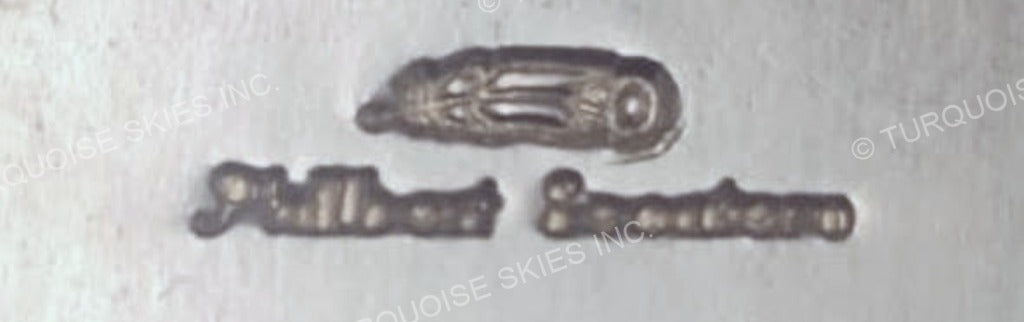
Need help identifying who made your piece?
Check out our Silversmith Directory of hallmarks →From the T.Skies Journal
- Turquoise Value, How Much is Turquoise Worth?
- Fake Turquoise Jewelry
- Grading Turquoise Color: What Color of Turquoise is Worth More?
- Kingman vs. Sleeping Beauty Turquoise: How the Two Arizona Mines Differ
- New Mexico Turquoise: The Four Historic Mining Districts
- Grading Turquoise Matrix: What Turquoise Patterns are Made of