



Conchos

The world of Southwest jewelry is rich with traditional symbols that have stood the test of time. One such item is the concho, a beautiful silver disk that has been used to create stunning belts for generations. The concho is a versatile piece that has been adapted and transformed over the years, yet its popularity remains as strong as ever.


The early techniques of silversmithing were introduced to the Southwest by the Spanish, and Native American artists soon adopted and adapted these techniques to make them their own. One of the most iconic items they created was the concho, which gets its name from the Spanish word "concha," meaning "seashell." The earliest conchos were made by hammering and stamping silver dollars before stringing them onto strips of leather to create a belt. These belts were typically adorned with intricate stamped designs that were breathtaking in their beauty.
Today, concho belts are still a popular fashion accessory, and modern techniques have made them even more versatile than ever before. Instead of being attached to a leather belt with copper loops on the back, conchos can now be connected to each other by silver rings without the need for a leather backing. Belts without the leather are fitted with a hook at the end that allows them to be tightened or loosened as needed. For leather belts, there is either a regular buckle at the end or a prong that can be inserted into a hole in the belt.


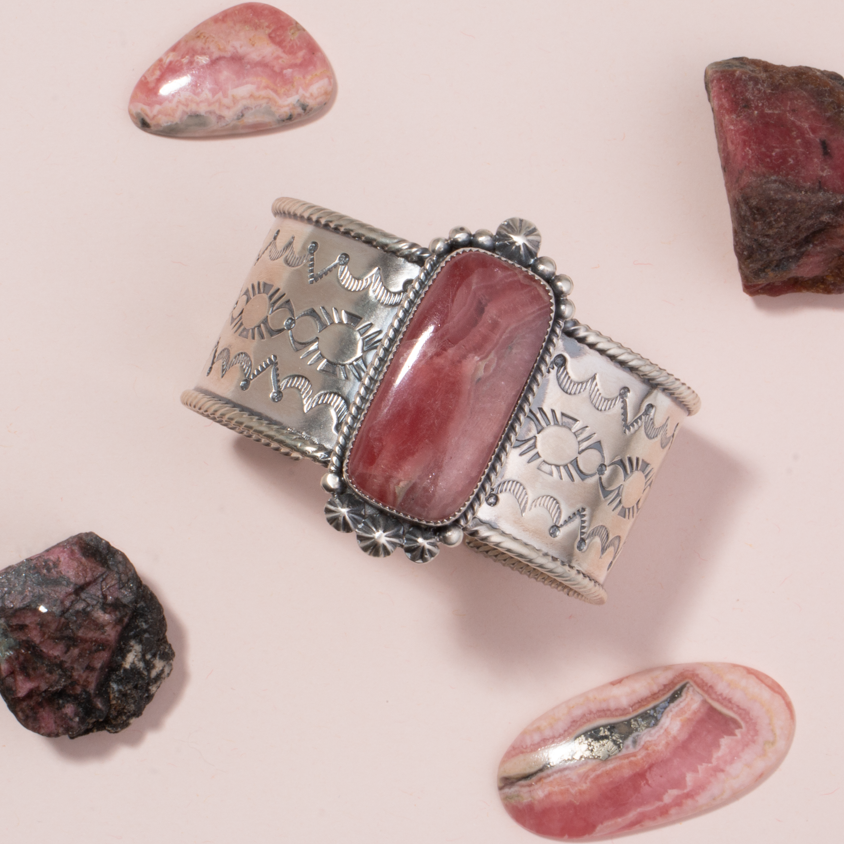
One of the most striking features of a concho belt is the intricate stamped designs that adorn the silver disks. Some artists also add turquoise stones or other gems to their conchos, adding a touch of color and texture to the piece. The addition of turquoise jewelry to the concho is particularly striking, as turquoise is a beloved gemstone in the Southwest and is often used in Native American jewelry. The combination of real silver jewelry and turquoise jewelry creates a stunning effect that is truly unique.
Concho belts are typically worn over clothing, as they are too large to fit through belt loops. They are a favorite accessory for both men and women and can be worn with a variety of outfits. They are a strong symbol of the adaptability of Native culture and artistry, and their popularity shows no signs of waning. In fact, the beauty and versatility of the concho make it an enduring symbol of the Southwest and a treasured piece of handmade jewelry that will continue to captivate people for generations to come.
The concho is a classic symbol of the Southwest and a beautiful example of the artistry and craftsmanship of Native American jewelry. Its enduring popularity is a testament to the adaptability and resilience of Native culture, and its beauty and versatility make it a treasured piece of handmade artisan jewelry that will continue to captivate people for years to come. Whether adorned with turquoise or other gems, the concho belt is a true masterpiece of Southwest jewelry that should be cherished and celebrated.
From the Library: Tanner, Navajo Silver Craft (1954)
1954 primary source. Anything described as current here describes 1954, not today.
Tanner (1954, p. 28) set out two possible origins for the concha. One authority traced it to the round or oval metal plates that Plains men wore on their long braids; since the Navajo did not wear long braids, they strung the plates on leather and wore them at the waist. The other possibility was the concha at the sides of the Mexican bridle's headstall. [1]
Tanner (1954) leaned toward the Mexican source:
“It is possible that the Mexican headstall concha decoration was more directly influential on the Navajo concha than was the decoration on the Plains metal piece.”
— Tanner (1954), p. 28 [1]
According to Tanner (1954, p. 28), for some years the Navajo made simple round and slightly oval conchas with only the barest touch of straight-line decoration from a cold chisel or file, or a little tracery with an awl; scalloped edges were an early feature and stayed popular. [1]
Tanner (1954) gave collectors a dating clue:
“Early in time, too, is the diamond shaped slot in the center of the concha for the leather lacing of the belt; later types are solid.”
— Tanner (1954), p. 28 [1]
On stones, Tanner wrote in 1954:
“Turquoise settings in conchas do not occur until about the turn of the century, and they did not become popular until about 1920.”
— Tanner (1954), p. 28 [1]
Tanner (1954, p. 28) compared old and new belts: older conchas could reach four inches or more across, and an old belt usually had seven of them, while many belts of 1954 were smaller and lighter, with twelve or more conchas, in rectangular, square and other shapes as well as round and oval. [1]
According to Tanner (1954, p. 28), the earliest buckles on concha belts were purely functional; smiths later made them larger and more varied, and a buckle often carried out the decorative theme of the conchas. [1]
From the Library: Dubin, North American Indian Jewelry and Adornment (1999)
1999 primary source. Anything described as current here describes 1999, not today.
Writing in 1999, Dubin dated Plains stamping much earlier:
“By the 1820s, southern Plains metalworkers, who probably learned their craft from Mexican blacksmiths, had mastered the basic processes of cutting, stamping, and cold hammering.”
— Dubin (1999), p. 284 [2]
Dubin (1999, p. 286) described hair plates as an early southern Plains men's ornament that possibly evolved from round silver brooches, and wrote that they were common on the Plains between 1835 and 1870. [2]
Dubin (1999) captioned an early Plains concha belt:
“The stamped Sioux-made German-silver plates are attached to a leather harness. c. 1875.”
— Dubin (1999), p. 286 [2]
From the Library: Franciscan Fathers, An Ethnologic Dictionary of the Navaho Language (1910)
1910 primary source. Anything described as current here describes 1910, not today.
Writing in 1910, the Franciscan Fathers described the concho belt of their day:
“A favorite silver ornament, worn with much pride and show, are leather belts, upon which are strung from ten to twelve plates or disks of silver.”
— Franciscan Fathers (1910), p. 280 [3]
According to the Franciscan Fathers (1910, p. 280), the disks were usually oval with a scalloped edge, slightly arched in the center, and about four and one-half inches long by three inches wide. [3]
The Franciscan Fathers (1910) continued:
“The belt is closed in front with a large, highly ornamental buckle. Each disk averages about three dollars in weight, so that a belt of this kind often contains silver to the value of forty dollars or more. On the lower side of each disk one or two cleats of copper wire is soldered for passing through the strap.”
— Franciscan Fathers (1910), p. 281 [3]
Writing in 1910, the Franciscan Fathers recorded who wore the silver belt:
“Belts, consisting of large silver disks of silver strung upon a strip of leather, are worn by both men and women, though the men usually girth themselves with a leather cartridge belt and sixshooter.”
— Franciscan Fathers (1910), p. 465 [3]
Of the women, the Franciscan Fathers (1910) wrote:
“About the waist is wound a long red sash, or the silver belt.”
— Franciscan Fathers (1910), p. 465 [3]
Writing in 1910, the Franciscan Fathers described the belt again in their section on leatherwork:
“The belt, consisting of an ordinary leather strap, is usually hidden under massive silver disks, and buckled in front with a silver or other buckle. The belt is worn by men, women and children, and is adorned accordingly, with from seven to eight of these silver disks.”
— Franciscan Fathers (1910), p. 312 [3]
The Franciscan Fathers (1910) added that younger men were turning to another belt:
“The cartridge belt, however, with profusely decorated holster, containing a pearl-handled six-shooter, appeals very favorably to many of the younger Indians, so that the use of the silver belt is confined almost exclusively to women and maidens.”
— Franciscan Fathers (1910), p. 312 [3]
From the Library: Branson, Indian Jewelry Making, Vol. 1 (1977)
1977 primary source. Anything described as current here describes 1977, not today.
Branson (1977) dated the belt's arrival:
“This unique and intriguing article of adornment appeared on the Navajo reservation sometime around 1870.”
— Branson (1977), p. 29 [4]
His account of where it came from (Branson, 1977):
“It is probable that the belt was copied from a combination of the Mexican concha or button and the nickel silver plain domed belt concha which was usually a machine-manufactured item sold to the Indians of the east and central plains.”
— Branson (1977), p. 29 [4]
Branson (1977, p. 27) wrote that the buckles on the very early belts were small next to the conchas, but that photographs of Navajos from around 1900 show many larger buckles, some worn alone on belts without conchas. [4]
The butterfly spacer between the conchas, Branson (1977, p. 28) wrote, was of unknown origin and appears in pictures of Navajos wearing concha belts sometime after 1900. [4]
From the Library: Branson, Indian Jewelry Making, Vol. 2 (1979)
1979 primary source. Anything described as current here describes 1979, not today.
Branson (1979) on telling a woman's belt from a man's:
“The belt with numerous small stones is usually a woman's belt. The ones with larger stones are worn more by the men.”
— Branson (1979), p. 26 [5]
Field Notes by Mateo James
I notice that this article describes the earliest concho belts as typically adorned with intricate stamped designs. Tanner (1954, p. 28) describes the early conchas differently: for some years they were simple round and slightly oval plates with only the barest touch of straight-line decoration from a chisel or file, or a little awl work. I show both descriptions.
The Franciscan Fathers give two counts for this belt in the same book: ten to twelve disks on page 280, seven to eight on page 312. Both passages are quoted on this page as they were printed.
Sources
- Tanner, Clara Lee. “Navajo Silver Craft.” Arizona Highways 30, no. 8 (August 1954): 16–33. Cited by printed page. Statements describe conditions as of 1954.
- Dubin, Lois Sherr. North American Indian Jewelry and Adornment: From Prehistory to the Present. Original photography by Togashi, Paul Jones, and others. New York: Harry N. Abrams, 1999. Cited by printed page. Statements describe conditions as of 1999.
- Franciscan Fathers. An Ethnologic Dictionary of the Navaho Language. Saint Michaels, Arizona: The Franciscan Fathers, 1910. Public domain (U.S. publication before 1931). Cited by printed page. Statements describe conditions as of 1910.
- Branson, Oscar T. Indian Jewelry Making, Volume I. Tucson: Treasure Chest Publications, 1977. Cited by printed page. Statements describe conditions as of 1977.
- Branson, Oscar T. Indian Jewelry Making, Volume II. Tucson: Treasure Chest Publications, 1979. Cited by printed page. Statements describe conditions as of 1979.


